

AI Voice Assistant Phone: How Businesses Are Replacing Legacy IVR Systems and Cutting Call Handling Costs by 80%
Most phone systems today do not have a technology problem. They have a resolution problem.
Customers call. They navigate menus. They get transferred. They call again. Each one of those steps costs money and erodes trust. The average cost per call in a traditional contact center can reach $12 when you factor in agent salaries, overhead, and repeat contacts. Meanwhile, 60–80% of call volume involves routine tasks such as order status checks, appointment bookings, and account queries that do not require human intervention.
That is the problem an AI voice assistant phone system is built to fix. Not just faster call routing. Actual resolution.
TL;DR
IVR was built to route calls, not to resolve them. That gap is where most customer service costs hide. An AI voice assistant phone system handles routine calls end-to-end, reduces repeat contacts, and keeps agents out of work they should not be doing. Gartner projects conversational AI will eliminate $80B in contact center labor costs by 2026. The businesses catching up now are the ones building the advantage.
Why Are Legacy IVR Systems Failing Modern Customer Expectations?
IVR was designed in an era when routing a call to the right department was considered progress. Customers today expect to be heard, not managed.
The failure points are predictable:
- Long menus and repeated prompts push callers to hang up before they are even helped
- Incorrect routing sends customers to the wrong team, forcing transfers and re-explanation
- Static scripts cannot adapt when a customer's request does not fit a pre-set option
- Every escalation and callback adds load to agents who are already handling complex work
BuyaCar introduced conversational AI in 2024 and saw a 33% drop in call abandonment rates directly tied to reduced lost sales. That number reflects the real cost to customers who left because the phone system made it too hard to stay.
IVR is not neutral. It is actively pushing customers away.
What Are the Hidden Costs of Traditional IVR Systems?
The cost of IVR shows up in places most ops leaders are not measuring directly.
The metric most teams track is cost per call. The metric that actually matters is cost per resolved issue. Those two numbers can look very different when your IVR is generating repeat contacts instead of resolutions.
A mid-sized credit management firm deployed voice AI to handle verification and payment reminder calls. The outcome: 40% reduction in agent workload, 30% drop in average handle time, and $95,000 in annual savings. Customer wait times fell from 8 minutes to under 3.
The hidden cost of IVR is not the system itself. It is the volume of work the system pushes onto agents and back onto customers.
How Do AI Voice Assistant Phones Solve These Problems?
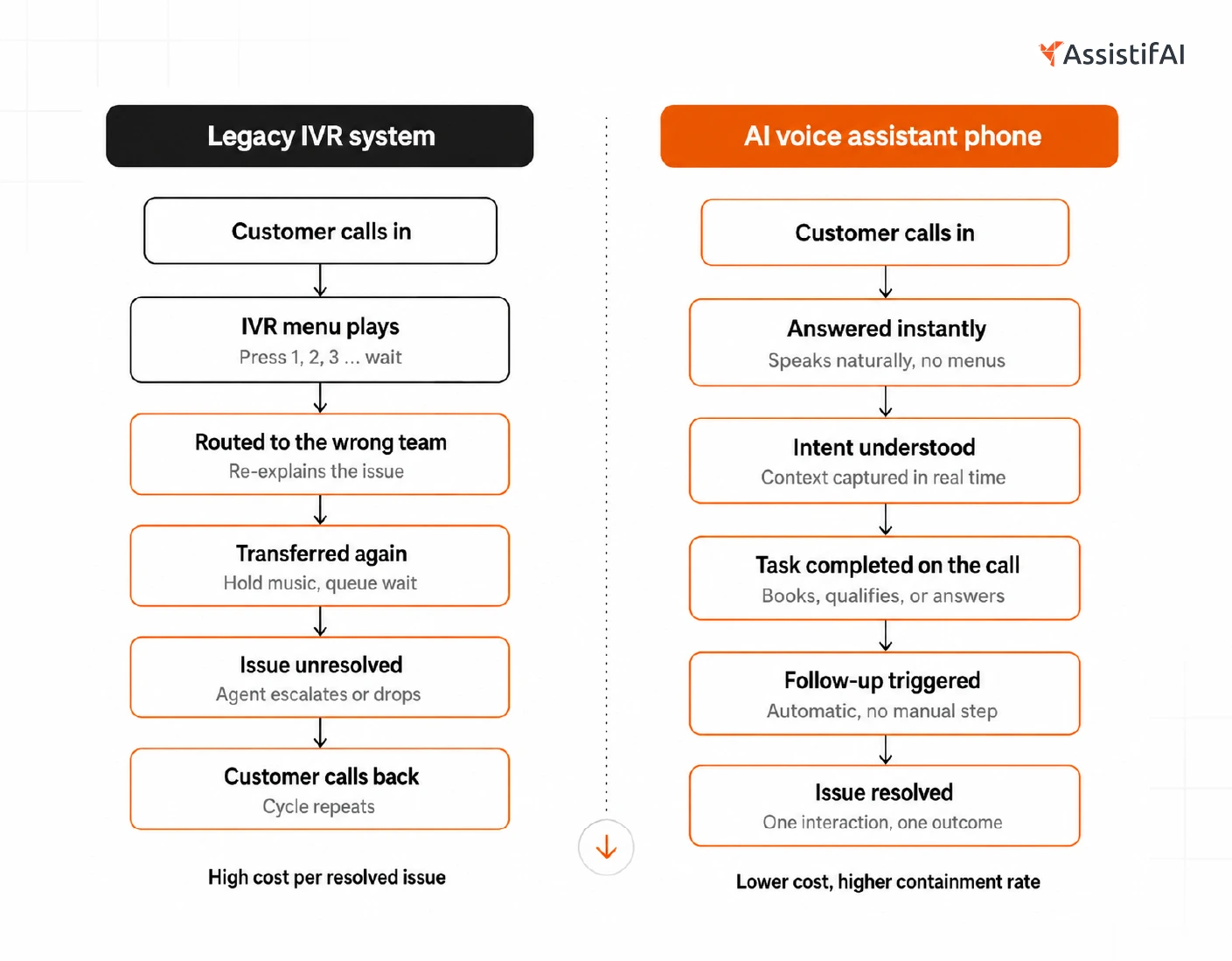
An AI voice assistant phone system replaces scripted menus with real conversation. Callers speak normally. The system understands, responds, and acts without requiring a button press or a transfer.
Does It Actually Understand Natural Conversations?
Yes. Modern voice AI uses automatic speech recognition and natural language processing to interpret what a caller is saying in real time. It handles interruptions, follow-up questions, and context shifts that would break a traditional IVR tree.
The result: no menu navigation, fewer misrouted calls, and callers who reach a resolution in the same interaction they started.
Can It Handle Customer Requests End-to-End?
This is where AI voice assistants separate from basic voice bots. End-to-end handling means the system not only understands the request, but it also completes it.
- Appointment booking happens on the call, not sent to a queue
- Account queries get answered from connected data, not forwarded to an agent
- Follow-ups are triggered automatically when the call ends
- Escalation happens only when the request genuinely requires a human
McKinsey data shows companies that adopt AI-driven automation in customer engagement reduce operational costs by up to 40% while improving customer satisfaction scores by 25% or more. That gap closes when the system can finish the task, not just understand it.
Does It Work Across Multiple Customer Channels?
Your customers do not only call. They text, use WhatsApp, and submit web forms often about the same issue. A voice-only system still creates silos.
An AI voice assistant that works across phone, chat, WhatsApp, and web forms keeps context across channels. A customer who started a conversation via chat and then called does not have to repeat themselves. That continuity is where the real friction gets removed.
How Do You Measure the Impact of AI Voice on Call Handling Costs?
Tracking the right metrics is what separates a real ROI story from a good pilot. Four numbers matter:
- Automation Rate: What percentage of calls does the AI handle fully, without any human involvement?
- Containment Rate: Of the calls the AI starts, how many are resolved without escalating to an agent?
- Resolution Rate: Of all calls (AI and human), what percentage resulted in the customer's issue being fully resolved?
- Cost Per Resolved Issue: The true efficiency number. Not cost per call. Cost per resolved issue.
Most IVR systems perform well in terms of automation rate because they deflect calls. They perform poorly on the resolution rate because deflection is not resolution. Tracking cost per resolved issue exposes that gap fast.
For businesses handling 1 million calls per year, with 30% handled by AI, annual savings can exceed $1.5 million, with breakeven in 1–2 years. For SMBs at lower volumes, the ratio still holds that fewer manual calls mean real capacity is freed for higher-value work.
How Do You Choose the Right Platform for Your AI Voice Assistant?
Not every voice AI platform is built for your business size, your tech stack, or your actual call types. Four things to evaluate before you commit:
Natural language understanding and language support. A platform that struggles with accents, domain-specific terms, or your customers' actual phrasing will generate more escalations, not fewer. Test it with real call transcripts before go-live.
Integration with your existing systems. An AI voice assistant that cannot connect to your CRM, ticketing platform, or scheduling system cannot complete tasks; it can only understand them. Resolution requires action, and action requires integration.
Verified performance metrics. Ask for data on automation, containment, and resolution rates from deployments similar to yours. Headline cost-saving figures mean little without knowing which use cases they came from.
Compliance and security standards. Voice data is sensitive. Confirm that the platform handles data in line with your regional privacy requirements and has the certifications your industry requires.
How Does AssistifAI Help Businesses Move Beyond Legacy IVR?
Most AI phone tools handle the conversation and stop there. AssistifAI is built to handle what comes after it, too.
The difference matters for teams that do not have separate tools for CRM, scheduling, follow-up, and reporting. AssistifAI replaces that fragmented stack with one system.
- Natural voice interactions with no menu friction: callers speak, the system responds
- Context carries across voice, WhatsApp, chat, and web; customers never repeat themselves
- CRM and workflow integrations run tasks automatically after the call ends
- Missed calls trigger callbacks without manual intervention
- Actionable insights from voice data show where calls drop and what converts
AssistifAI deploys without a developer. A website scan generates a working AI assistant in roughly 60 seconds. Workflow customization, like booking, follow-ups, routing rules, takes days, not months.
It is not a better IVR. It is the system that replaces the need for one.
When Should Human Agents Still Be Involved?
AI handles volume. Humans handle judgment. The line between them is clearer than most teams expect.
Human agents should stay in the loop for:
- Complex or high-value calls where the customer's situation does not fit a defined resolution path
- Emotionally sensitive situations where the caller needs empathy, not efficiency
- Compliance and verification tasks that legally require a human decision
- AI-flagged escalations where the system identified that the call exceeded its resolution scope
A well-designed AI voice system does not try to replace every human interaction. It removes the routine work so agents can give full attention to the calls that need it. That shift from volume handlers to problem solvers improves both agent experience and customer outcomes.
What Questions Should You Ask Before Choosing an AI Voice Assistant Platform?
Before signing anything, get direct answers to these:
How well does it understand context and intent? Ask for a live demo with your actual call types, not a scripted scenario. Real calls are messier than demos.
Can it integrate with the systems you already use? If integration requires custom engineering, your go-live timeline just doubled. Verify this before it becomes a problem.
Which metrics demonstrate real cost savings and improved resolution? Automation rate alone is not the answer. Push for containment rate and cost per resolved issue from real deployments.
How does it handle escalation, failure, and edge cases? Every AI system has limits. The quality of the handoff to a human agent, and whether context is preserved, are often the most important questions.
What Does the Future of Customer Service Look Like?
The shift is already happening. AI is moving from call routing to end-to-end resolution, and the contact centers that see the biggest gains are the ones that stopped treating voice AI as a cost-cutting tool and started treating it as a resolution system.
Businesses gain measurable savings. Customers get faster answers. Human agents work on problems that actually need human judgment.
Intelligent voice platforms like AssistifAI are becoming central to how modern operations run, not because they are impressive technology, but because they fix a real operational problem that legacy IVR never could.
If your phone system is still routing calls instead of resolving them, that is the gap worth closing.
FAQ
What is an AI voice assistant phone system?
An AI voice assistant phone system uses speech recognition and natural language processing to handle inbound and outbound calls without a human agent. It understands spoken requests, responds in real time, and completes tasks such as booking appointments, answering account queries, and automatically triggering follow-ups.
How is an AI voice assistant different from an IVR system?
IVR routes calls using pre-recorded menus and button presses. AI voice assistants understand natural speech, hold real conversations, and resolve requests end-to-end without requiring callers to navigate a menu tree or repeat themselves to multiple agents.
Can a small business use an AI voice assistant phone system?
Yes. No-code platforms like AssistifAI are built for non-technical teams. A working assistant can be deployed in minutes without an IT department or developer. Workflow customization, such as scheduling, follow-ups, and CRM integration, typically takes days, not months.
What metrics show whether an AI voice assistant is actually reducing costs?
Track automation rate (calls handled fully by AI), containment rate (calls resolved without escalation), and cost per resolved issue. Cost per call is a weaker signal; it misses the cost of repeat contacts generated by unresolved calls.
What happens when the AI cannot resolve a call?
A well-designed system escalates to a human agent and passes along the full call context so the agent does not start from scratch. How cleanly that handoff works is one of the most important things to test before choosing a platform.
How long does it take to replace an IVR system with AI?
With a no-code platform, a basic deployment can go live in hours. AssistifAI generates a working assistant from a website scan in roughly 60 seconds. Full workflow configuration (booking, follow-ups, integrations) typically takes days, not the months a developer-dependent platform would require.

Read More Blogs

Your next hire isn't human.


AssistifAI automates your workflows and delivers exceptional voice and chat-based customer support helping your business grow faster, save time, impress clients, and stay ahead of the competition.