

AI Voice Assistant CRM Integration: How to Connect Your AI to Your Sales Stack in Under 2 Minutes [No-Code]

TL;DR
Problem: While your AI voice assistant handles prospects, your CRM still requires manual updates. Follow-ups get missed, and leads go cold because their voice tool and CRM are two separate systems with no real connection.
Shift: Real-time CRM integration is not a nice-to-have feature. It is the difference between a voice assistant that handles calls and one that actually moves deals forward.
Fix: AssistifAI, AI voice assistant crm integration connects your voice assistant to the entire sales stack in under 2 minutes. No flowcharts. No developers. No workflow builders. Just configure in plain language and deploy.
Why Is Real-Time CRM Integration Your Sales Superpower?
Real-time CRM integration means a fully connected system that handles conversations at scale. They answer calls, qualify leads against set criteria, update your CRM automatically, and respond to basic queries without a human rep on the line. That is real value, especially for SMBs that cannot afford to miss inbound calls after hours.
Voice AI for a virtual business assistant that sits outside your CRM is just a fancy answering machine. It records the conversation, but nothing downstream changes. Leads are 9x more likely to convert when contacted within 5 minutes, and that window closes the moment your voice tool and CRM stop communicating.
Look at the image below. Companies using CRM applications can experience up to a 29% increase in sales and a 42% improvement in sales forecast accuracy.

- CRM applications can increase sales by up to 29%, boost productivity by 34%, and improve forecast accuracy by 42%, according to Salesforce.
- Sales teams implementing real-time CRM sync report lead conversion rates rising by up to 300% (Forrester).
The word "real-time" is doing something serious here. A lead that calls at 9 am and gets a follow-up at 3 pm has already gone cold. Real-time means your system acts within seconds of the conversation ending.
Without real-time integration, your AI voice assistant is simply attending calls with a marketing budget.
AssistifAI Replaces the Broken System Behind Your Calls, Not Just the Call Handler
AssistifAI is not another voice bot with a CRM plugin. It entirely replaces the fragmented system behind your sales calls.
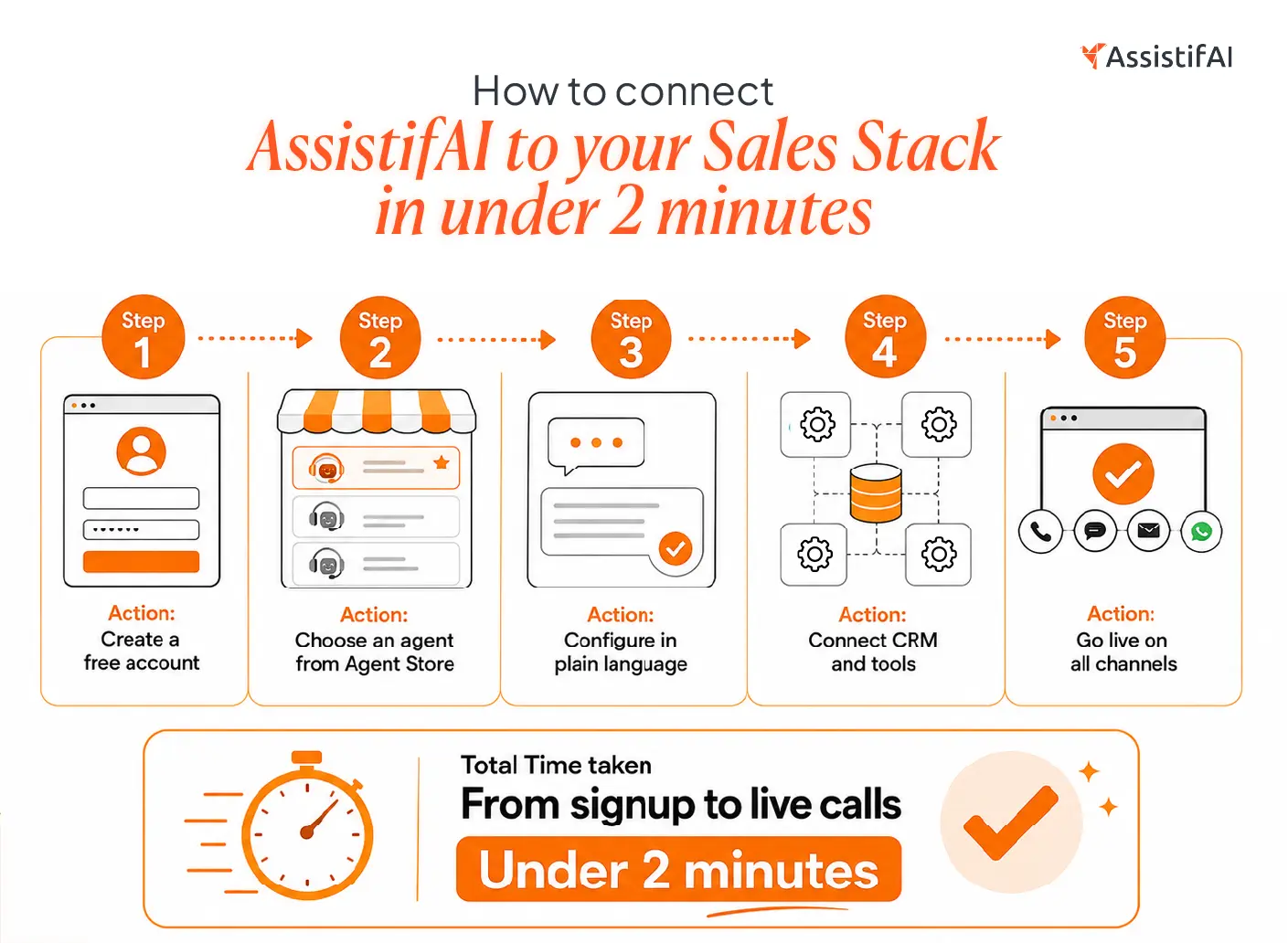
The tagline is accurate: set up your AI assistant in minutes and adapt anytime. Most SMB teams can go live in under 2 minutes because setup is done through plain-language instructions rather than flow builders.
Don’t see it as marketing copy; it is the experience, and it matters because most competitors measure setup time in days or weeks.
Connect→Automate→Sync
This is what AssistifAI does.
Here is what makes it structurally different:
- Natural language configuration: You describe what you want in plain English. No flowcharts. No intent mapping. No decision trees.
- 1-minute deployment: The setup time is real. You go from signup to live calls in under 2 minutes.
- Built-in workflow engine: Calls do not just get logged. Follow-ups trigger. CRM records update. Next steps fire automatically.
- Agent Store: The Agent Store lets you install ready-to-use agents instantly. There is no need to build from scratch.
Most tools give you features. AssistifAI gives you control over outcomes.
The difference is not cosmetic. When a lead calls in, this enterprise voice AI assistant handles the conversation, updates the CRM, and triggers the follow-up, all in a single place. That is the system working, not just the tool.
The 2-Minute Setup: How to Connect AssistifAI to Your Sales Stack
What SMBs Actually Gain: Faster Response, Cleaner CRM, Zero Dev Dependency
Voice AI for a virtual business assistant changes how sales function for SMB owners and startup founders.
You don’t need:
- A dedicated ops team
- Complex tool stacks
- Time spent managing workflows
Instead, you get:
- Faster response times
- Consistent follow-ups
- Cleaner CRM data
- Higher conversion rates
The system works in the background, without constant input.
Conclusion: Sales Do Not Fail Because of Effort. It Fails Because the System Is Broken
Just remember that your team is not the bottleneck. The real villain is the disconnected stack of tools they operate inside. AI is only useful when it removes complexity from that stack, not when it adds another tool that someone needs to update manually.
The shift is simple: stop treating your voice assistant as a standalone call-handler and start treating it as the front door to a fully automated sales workflow.
AI voice agents qualify leads with more accuracy than human SDRs. Why? The reason is simple. It doesn’t get emotional or skip steps, even at 11 pm. Consistency beats talent here. After the end of each conversation, it never sits idle. The system is already two steps ahead: CRM updated, follow-up scheduled, rep notified.
That is what AssistifAI, an AI voice assistant CRM integration, is built to do.
- Set it up in under 2 minutes.
- Adapt it anytime. Let the system do the work your stack was never designed to handle.
Set up your AI assistant and connect your sales stack
FAQs
What is AI voice assistant CRM integration?
AI voice assistant CRM integration is the automatic connection between a voice-based AI agent and your customer relationship management system. The goal is to close the gap between conversation and action inside your sales pipeline.
How long does it take to integrate an AI voice assistant with a CRM?
With most traditional platforms, setup takes days or weeks because you need to configure flows, map intents, and test logic. With AssistifAI, the integration takes under 2 minutes. You configure using plain language, connect your CRM, and deploy without extra effort from a technical team.
Do I need a developer to connect an AI voice assistant to my CRM?
No, if you use the right platform. Most no-code voice tools still require technical configuration through visual builders or API setups. AssistifAI is built so that a non-technical operations lead or founder can set up and manage the entire integration independently, using natural language.
What happens to CRM data after an AI-handled call?
In a properly integrated system, the CRM record updates automatically after every call: contact details are logged, the call outcome is recorded, deal stage changes are made if applicable, and a follow-up task is triggered. In a basic integration, only the call log syncs; everything else still requires manual input.
Which CRMs work with AI voice assistants?
Most enterprise voice AI platforms support popular CRMs, including HubSpot, Salesforce, Zoho CRM, and Pipedrive, either natively or via middleware such as Zapier. Native integrations are always preferable because they support real-time updates and bidirectional sync, whereas middleware connections often lag and require additional maintenance.
What is the difference between an AI voice assistant and a standard IVR system?
An IVR (Interactive Voice Response) system routes calls based on keypad input and preset menus. An AI voice assistant holds a real two-way conversation, understands natural language, qualifies leads, answers questions, takes actions, and connects to your CRM without any manual work.

Read More Blogs

Your next hire isn't human.


AssistifAI automates your workflows and delivers exceptional voice and chat-based customer support helping your business grow faster, save time, impress clients, and stay ahead of the competition.