
Best AI Call Center Voice Agent Platforms in 2026: Full Comparison & Buyer's Guide

TL;DR: Most Voice AI fails where it matters — Speed, Accuracy, and Real Conversations
Problem: Most companies don’t have a staffing problem. They have a response problem. Calls get missed, agents get overloaded, and customers drop off.
Shift:
- AI voice agents now handle 60–80% of inbound calls in the health care and e-commerce industries.
- Businesses report 30–50% cost reduction in call handling.
- Response time drops from minutes to seconds.
Fix: The fix is not “adding AI.” Instead, choose the right AI call center voice agent that delivers low latency, better customer experience, high accuracy, and real integration.
Traditional Call Centers Are Bleeding Revenues: Why?
They are slow, expensive, and inconsistent.
You are paying for people to do repetitive work. At the same time, customers expect instant responses. That gap is where revenue is lost.
What actually goes wrong in real scenarios?
- Unanswered calls during peak hours.
- Agents repeat the same answers all day.
- Training takes weeks, but performance still varies.
- Poor call center support at night.
What is an AI Call Center Voice Agent?
An AI call center voice agent is software that answers and handles phone calls using speech AI instead of human agents.
It listens, understands, responds, and completes tasks such as booking, support, and qualification.
How is this different from old IVR systems?
Old systems route calls.
AI voice agents resolve them.
What does a real AI voice agent do?
- Understands natural speech, not just commands.
- Responds in real time without long delays.
- Integrates with CRM, calendars, and backend systems.
- Handles end-to-end conversations.
If it cannot do these four things, it is not a serious tool.
Best AI Voice Agent Platforms: What They Do Well and What They Still Miss
Not all tools are built the same. Some are developer-first. Some are plug-and-play. Some break under real call volume.
Here’s a clear comparison.
How do these platforms actually differ in real usage?
Each of these platforms solves a specific layer. None solves the full system.
Chatbase
Strong entry point for chatbot users moving into voice. But voice is still an extension, not the core system.
Retell AI
Great for real-time conversational handling. But it leans toward developers. Teams still need to connect backend actions and workflows themselves.
Bravi
Good for support automation with quick integrations. But deeper customization and operational control are limited.
Simpletalk
Works well for structured, predictable flows. Struggles when conversations move outside predefined paths.
What we infer: Most comparisons focus on features. That is not useful. What matters is how those behave under pressure.
Where do most tools fail?
- The delay between the question and the response.
- Poor understanding of accents or noisy audio.
- Broken workflows when the user goes off-script.
- No real backend integration.
How does AssistifAI close this gap?
AssistifAI is built as a system, not a voice layer.
It moves every interaction forward, not just answers calls.
What makes it different
- Conversations happen across voice, chat, and messaging.
- Workflows execute automatically after every interaction.
- Follow-ups and nudges are built into the system.
- Routing, booking, and qualification happen instantly.
- Visibility exists across the full journey.
No stitching tools together. No manual coordination.
What outcomes does AssistifAI actually drive?
Faster response
Calls are answered instantly. No waiting.
Fewer missed opportunities
Every lead is captured and processed.
Better follow-up completion
Follow-ups happen automatically, not manually.
Less manual coordination
Teams don’t chase tasks across systems.
Clear visibility
You see what is working and what is not.
How does an AI Phone Call Agent actually work?
It uses a pipeline of speech recognition, reasoning, and voice output.
The traditional pipeline problem
STT → LLM → TTS
(Speech to text → AI reasoning → text to speech)
Problems: Delays and robotic responses.
What are modern AI Call Centers doing now?
- Streaming responses instead of waiting.
- Partial understanding while the user is speaking.
- Faster voice synthesis.
- Better conversation memory.
Benefits: Reduces latency and improves experience.
What should you actually look for before buying?
The future of call centers is automation. Always choose the best AI call center voice agent to automate inbound or outbound calls.

What does a real implementation look like?
An average healthcare call center has hold times exceeding 4 minutes, and only 50% of issues are resolved on the first contact, leading to repeated follow-ups and time wastage.
An AI call center voice agent resolves this issue. When a clinician flags a claim on hold, the agent pulls data from the EHR, checks payer rules, identifies missing details, and triggers corrections. It can also collect documents, resubmit claims, and route approvals with full context when needed.
The result is clear:
- Higher first-contact resolution.
- Shorter wait times.
- Less internal back-and-forth.
- Focused patient care.
The shift was not “AI adoption.”
It was removing bottlenecks.
Most AI Voice Rollouts fail within a few days, and it's never a technology error.
Companies expect magic and skip setup.
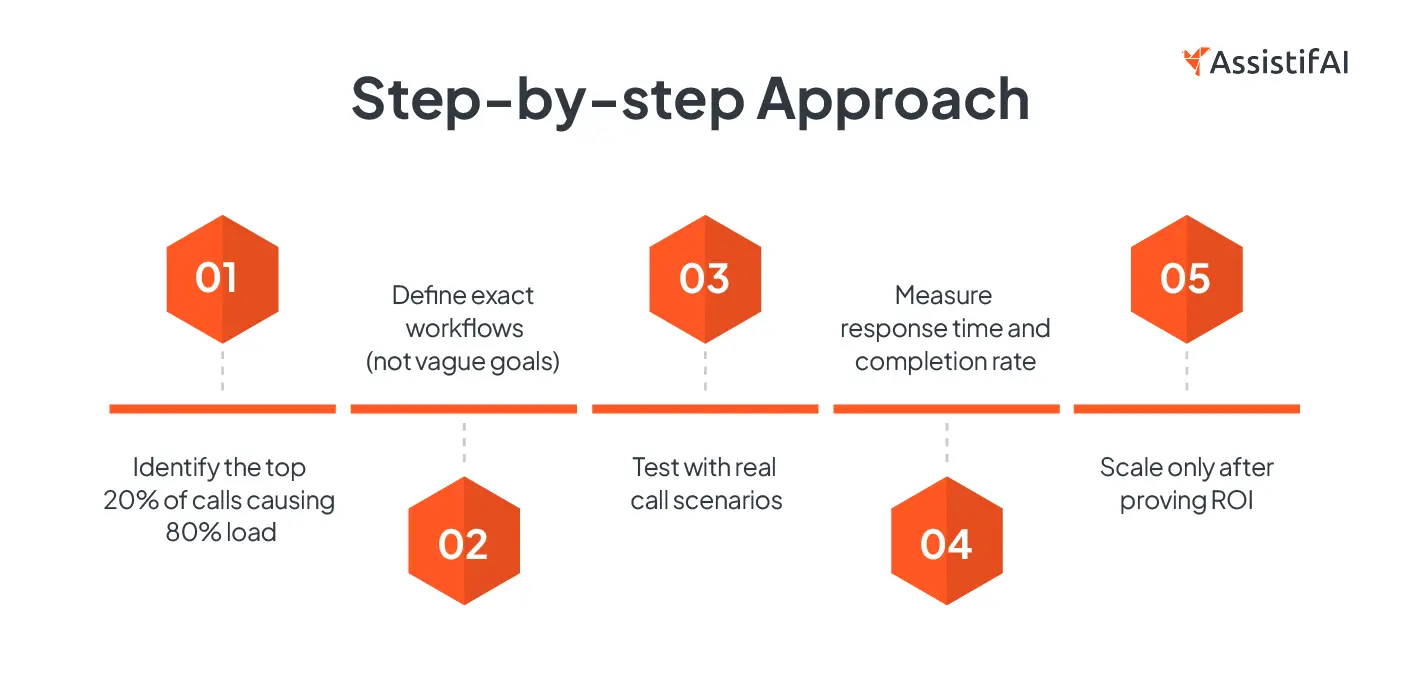
The 5-Step Framework to Make Production Deployments Scale—Not Fail
What should you do next?
If your call center is growing, costs will grow faster.
AI voice agents are no longer optional. They are operational infrastructure.
The question is no longer “Should we use AI voice agents?” The real question is: How much revenue are you losing without one?
Hire the best AI phone call agent that is a win-win for businesses and customers.
AssistifAI stands out as the best AI Call Center Voice Agent.
Most tools sell capabilities. AssistifAI sells control over outcomes.
Others give you a voice bot. AssistifAI replaces the messy system behind your calls.
It is not just an AI call center voice agent. It is a full execution layer.
FAQs
What is an AI call center voice agent in simple terms?
An AI call center voice agent is software that answers phone calls, understands speech, and responds like a human agent while completing tasks such as booking, support, or lead qualification.
How accurate are AI voice agents in real conversations?
Accuracy depends on the platform, but top tools now achieve high accuracy in controlled workflows. Performance drops if conversations are too open-ended or poorly designed.
How does an AI call center agent save money?
An AI call center agent can automate up to 90% of customer queries, which means you need 90% less human agents to address customers. You eliminate all the costs associated with recruiting, training, managing, and operating human agents.
What industries benefit the most from AI phone call agents?
Healthcare, real estate, ecommerce, logistics, and customer support-heavy businesses experience a significant impact on ROI due to high call volumes and repetitive queries.
How much does an AI call center agent cost?
Costs vary widely depending on usage, but most businesses see a 30–50% reduction in operational costs compared to traditional call centers.
How long should we wait to implement an AI voice agent?
Simple setups can go live in days. Complex integrations with CRM and workflows may take a few weeks.

Read More Blogs

Your next hire isn't human.


AssistifAI automates your workflows and delivers exceptional voice and chat-based customer support helping your business grow faster, save time, impress clients, and stay ahead of the competition.