

What is an AI Voice Assistant? The Complete Business Guide for 2026

Customers wait for no one. Even an unanswered call will create revenue loss in business.
That is where modern AI voice assistants excel.
Such technology makes work easier and faster because these autonomous AI agents are working on unified workforce platforms. And businesses can reduce costs, increase responsiveness, and deliver personalized services at scale.
Conversational AI voice assistants are no longer just customer service tools. They are the right business strategies across industries.
AI voice assistants enhance customer interactions by autonomously completing complex tasks without requiring human intervention at every step.
In 2026, AI voice assistants will be used a lot more in customer service, sales, and lead generation.
What is an AI Voice Assistant?
An AI voice assistant is a software program that uses AI to talk to people.
It uses speech recognition, natural language processing (NLP), and text-to-speech (TTS) technologies to understand and respond to spoken commands.
What makes modern AI voice assistants stand out is not just that they can recognize words but that they can reason through requests.
They can understand natural conversation and context and respond in a way that feels relevant to the situation rather than relying only on fixed command patterns.
LLM plays a crucial role in the functioning of AI voice assistants. They arrive at logical conclusions by interpreting edge cases, manage ambiguous phrasing, and connect ideas across a conversation.
Modern AI voice assistants are built to understand complex language patterns, learn from past interactions, and continuously improve over time.
If the system doesn’t recognize the request or if it’s not covered by the menu options, the user may become frustrated and have to repeat themselves or wait for a human agent.
How Do AI Voice Assistants Actually Execute Tasks?
Modern AI voice assistants work with an integrated architecture designed for real-world action. Businesses find such technology useful, as it operates from simple command tools to action-oriented systems that can understand, reason, and execute tasks effortlessly.
- ASR (Automatic Speech Recognition)
The first step is giving user input in the form of a voice command, a text-based message, or even a click within a conversational AI client. The user tells the assistant what they want to solve or what they want to complete. When you speak, your speech is converted into structured data almost instantly. Instead of “hearing” like humans, they predict the most probable words based on patterns learned from large datasets.
Advantage: This idealistic approach increases the workflow and enables consistent performance across accents, noise levels, and speaking styles.
- NLU (Natural Language Understanding)
Now it has your words, but it needs to understand your intent.
"Schedule a 30-minute call with the sales team next Tuesday at 2 p.m." and "Remind me to call the sales team at 2 p.m. Tuesday" are the same thing.
NLU analyzes both and interprets them based on context and intent. It also extracts entities (7 am, tomorrow, sales team) and records what "it" and "there" refer to from earlier in the conversation.
Advantage: Users can speak naturally without needing to follow rigid commands, making interactions faster and more intuitive.
- LLM-Powered Reasoning and API Orchestration
AI voice assistants don't depend on a predefined decision set. They use large language models to reason through requests, handle ambiguity, and decide the next best action.
They can dynamically call external systems such as calendars, CRMs, support tools, or payment APIs to complete tasks.
Advantage: The assistant goes from just answering questions to actually carrying out tasks like making appointments, answering questions, or starting business processes in real time.
- TTS (Voice Synthesis):
Modern voice synthesis is shockingly adept at producing speech.
Most of what you think sounds "robotic" is actually a deliberate design choice to signal "I'm an AI," not a technical limitation.
The system streams audio chunks, so you start hearing the response before it's fully generated. That's how your AI assistant can talk and act like a friend.
Advantage: This makes the conversation feel more immediate and human-like, which makes it seem like there is less latency.
The diagram below illustrates how an AI voice assistant functions:
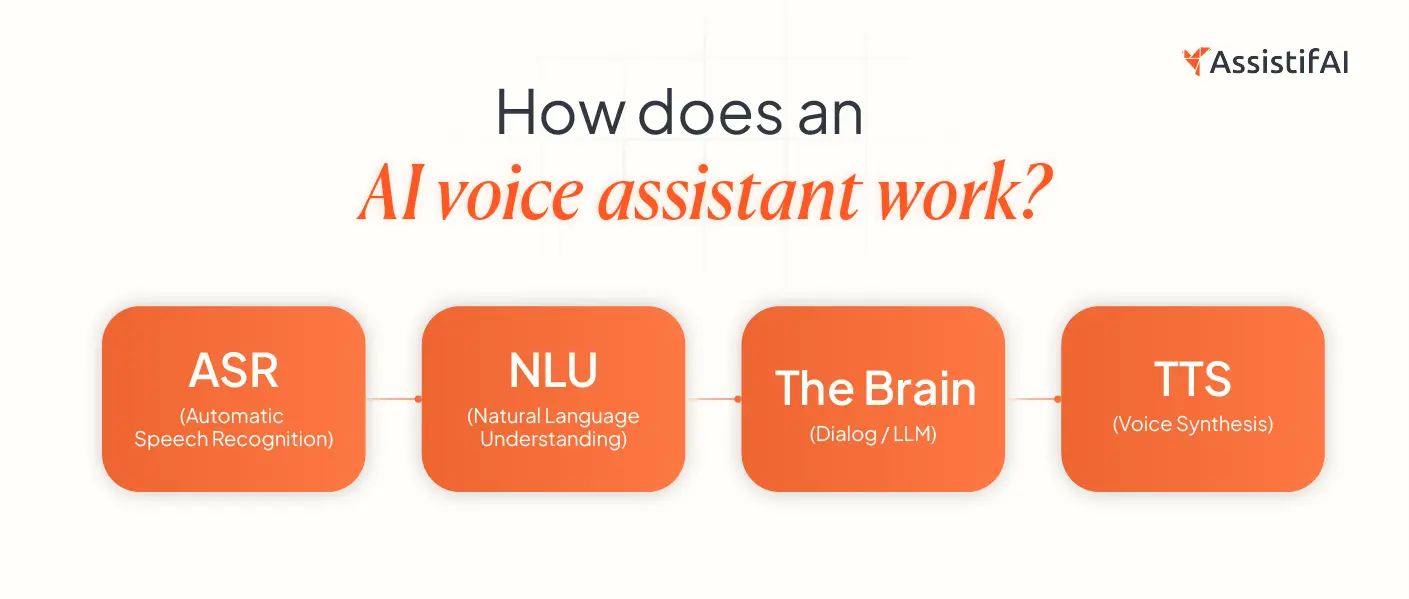
In essence, AI voice assistants are actually filling the gap between human language and machine understanding, making it easier for businesses to automate and improve interactions with customers and internal teams.
How Do AI Voice Assistants Drive ROI, Reduce Costs, and Improve CX?
Autonomous Customer Support
Today, customers want real-time, 24/7 availability and customized omnichannel engagement. If they don’t get the experience they want, they will pay more and simply move to another company that provides better service.
Also, they don't want to deal with frustrating menu-driven IVRs. A conversational AI voice assistant needs to give a high-quality customer experience.
By understanding customer needs, whether it’s answering queries, resolving issues, or guiding users through processes, AI assistants provide a seamless, more personalized experience.
It will reduce resolution time and boost customer experience (CX). Therefore, businesses won’t lose customers.
Over time, that directly strengthens ROI and adds strategic value by helping businesses protect revenue, retain loyal customers, and build stronger long-term relationships.
Optimizing with AI Voice Automation
Besides improving customer interactions, AI voice assistants are also simplifying internal operations. By effectively coordinating and managing routine tasks such as appointment scheduling, order processing, and FAQ handling, businesses can give their employees more time to focus on higher-value tasks.
This minimizes operational costs and boosts productivity, ensuring that employees are not bogged down by repetitive work.
For instance, businesses can adopt AI voice assistants to handle routine inquiries, allowing human agents to focus on more complex problems that require nuanced decision-making.
Lower costs and better operational efficiency
Adding AI voice assistants can cut costs, especially in customer service. AI voice assistants handle many customer service tasks.
This translates into a significant reduction in human interactions, thereby diminishing coaching, training, and support costs.
Additionally, a voice-enabled AI co-pilot can scale effortlessly to handle thousands of interactions simultaneously, which is extremely useful during peak periods.
In addition, AI assistants can continually learn and adapt, resulting in improved efficiency for the business.
This type of hyper-dynamic adaptability enables businesses to improve performance without increasing costs.
Where Are Businesses Using AI Voice Assistants Today?
AI Voice Assistants in Customer Care
AI voice assistants are helping boost client support, driving the market to adopt them to manage standard human support requests.
For instance, AI assistants can handle billing questions, order status requests, and basic troubleshooting and respond to customer questions in real time. This speeds up the process of answering questions and makes the client happier.
AI Voice Assistants for Sales and Lead Generation
AI voice assistants can help salespeople qualify leads by asking set questions and collecting important information from potential customers.
After that, human agents can take over this process to follow up, thereby speeding up the sales cycle and increasing conversion rates. AI voice assistants can also make follow-up calls, schedule appointments, and send reminders, allowing sales teams to focus on closing deals.
AI Voice Assistants in Healthcare and Finance
AI voice assistants in healthcare answer health-related questions and send medication reminders to patients. They also schedule patients' appointments.
In finance, AI voice assistants answer customers' queries about account balances and transaction histories and assist them with loan applications.
AI voice assistants in both industries make healthcare and finance services more streamlined and reachable. Because of these services, companies can serve more customers without hiring additional employees.
How to Choose an AI Voice Assistant That Delivers ROI
When choosing an AI voice assistant for your business, think about these things:
- Language Support: Can the assistant understand more than one language or dialect, and can it handle complicated questions?
- Ease of Integration: How well does the AI voice assistant integrate with your current systems, such as your CRM or helpdesk?
- Does it add strategic value to your business by strengthening ROI?
- Scalability: Can the assistant grow with your business as it gets bigger?
- Customization: Is it possible to tailor the assistant to your business needs and speaking style?
What Challenges Should Businesses Expect?
Accuracy & Misunderstanding in AI Conversations
Even though they are advanced in technology, AI voice assistants are still in the learning phase when it comes to understanding complex or ambiguous queries.
This challenge may frustrate user experiences. To tackle this challenge, businesses need to ensure their AI voice assistants are trained on high-quality, diverse datasets and regularly updated with new language patterns.
Data Privacy and Security Concerns
AI voice assistants are handling sensitive customer data day by day. It is essential not to breach customers' privacy and security. Businesses must check whether their voice AI solutions comply with data protection regulations such as GDPR and CCPA. Additionally, voice data should be encrypted and stored securely to prevent unauthorized access.
What is the Future of AI Voice Assistants in 2026?
AI voice assistants will keep getting better over time. In 2026, we can expect:
- Sentiment Analysis: Future AI voice assistants can gauge customer mood and adjust responses accordingly.
- Multimodal AI: Combining human voice with visual interfaces, like connecting voice interactions with on-screen data or chatbots.
- Deeper Personalization: AI voice assistants will try to understand what customers really want and provide tailored responses based on past behaviors and interactions.
These new trends will further increase the role of voice AI in business operations, making it an essential tool for staying ahead of the competition.
Is Your Business Ready for an AI Voice Assistant?
AI voice assistants are quickly becoming irreplaceable tools for businesses looking to improve efficiency, reduce costs, and deliver a better customer experience.
They support businesses by answering questions, setting reminders, and improving customer experiences. As we head into 2026, now is the perfect time to explore how voice automation can enhance your operations by increasing responsiveness and delivering personalized service.
Their role in customer support, sales, and lead generation will expand significantly, highlighting their value beyond just customer service interactions.
Voice your commands with AssistifAI: Your Perfect AI voice Assistant
Customers have already changed what they expect. That's the new normal: quick answers, 3 AM support, and easy conversations. It's not going back.
Most of the companies that struggle with AI voice don't fail because the technology isn't ready. They fail because they add a voice bot to a stack that is already disjointed, with different tools for scheduling, chat, and calls that don't communicate with one another. Automation theater is what's left over.
The businesses that figure this out have stopped thinking in individual tools and started thinking in unified systems.
That's exactly the problem AssistifAI was made to fix. It's the world's first unified AI workforce platform with six integrated pillars, replacing five to seven fragmented tools with a single, voice-first, zero-code system.
You will get an all-in-one platform for customer conversations, scheduling, phone operations, workflow automation, and conversation intelligence across web, WhatsApp, and phone.
Ready to integrate AI voice assistants into your business? [Create Your Free Assistant today] and discover how AssistifAI can transform your customer interactions.
Frequently Asked Questions (FAQs)
1. What is an AI voice assistant?
An AI voice assistant is software that understands spoken language, responds in natural conversation, and helps users complete tasks such as answering questions, booking appointments, routing calls, or resolving support issues. It typically uses speech recognition, natural language processing, and automation to handle voice interactions.
2. What is the best AI voice assistant for businesses?
The best AI voice assistant for businesses is the one that fits your goals, works with your existing systems, supports automation, and delivers natural conversations at scale. A strong solution should improve customer experience while reducing manual work for your team.
3. Why do businesses use AI voice assistants?
Businesses use AI voice assistants to handle routine conversations faster, offer 24/7 support, automate repetitive tasks, and reduce pressure on human teams. They also help improve response times, consistency, and service efficiency.
4. Is voice AI safe for business use?
Yes, voice AI can be safe for business use when the platform includes strong security, access controls, and proper data protection. The key is choosing a solution that meets your compliance needs and keeps customer information secure.
5. How can AI be used in customer support?
AI can support customer service by answering routine questions, routing calls, handling order or billing requests, assisting agents in real time, and giving customers faster help across voice and digital channels. This reduces wait times and frees human agents to focus on more complex issues.
6. How do AI voice assistants differ from traditional chatbots?
AI voice assistants are built for spoken, real-time conversations and can understand voice input, respond aloud, and manage call-based tasks. Traditional chatbots are usually text-first and often rely on simpler scripted flows, though newer AI chatbots can also use advanced language models.
7. Which industries are seeing the most growth in adopting AI voice assistants by 2026?
By 2026, the strongest growth is expected in customer service, retail, healthcare, and financial services because these sectors handle large volumes of repetitive interactions and benefit most from faster, scalable voice automation. Market reports also show rapid overall growth in conversational AI, AI for customer service, and AI voice agents.

Read More Blogs

Your next hire isn't human.


AssistifAI automates your workflows and delivers exceptional voice and chat-based customer support helping your business grow faster, save time, impress clients, and stay ahead of the competition.