
How No-Code AI Agent Platforms Help Automate Customer Conversations
TL;DR
Problem: Your business is paying to generate leads but losing them at the response stage, resulting in missed calls, slow replies, and no follow-up. A 2025 analysis by Ambs Call Center puts the average annual cost of missed calls for a small business at $126,000. That is not a staffing problem. It is a systems problem.
Shift: The businesses recovering those leads are not hiring more people. They are replacing fragmented, manual processes with a single AI execution layer that automatically handles conversations, follow-up, and routing.
Fix: No-code AI agent platforms let any business, without a developer and without months of setup, deploy an assistant that responds instantly across voice, chat, and messaging, and keeps every lead moving forward until it converts or closes.
Why Are Businesses Still Losing Leads They Already Paid For?
Most businesses spend on ads, SEO, and outreach to attract customers. Then they miss the call, reply to the message two days late, and forget to follow up. The lead disappears.
This is not a staffing problem. It is a systems problem. Fragmented tools don’t work properly. One is for calls, one for CRM, and one for follow-ups, creating gaps that no team can close manually at scale.
No-code AI agent platforms close those gaps.
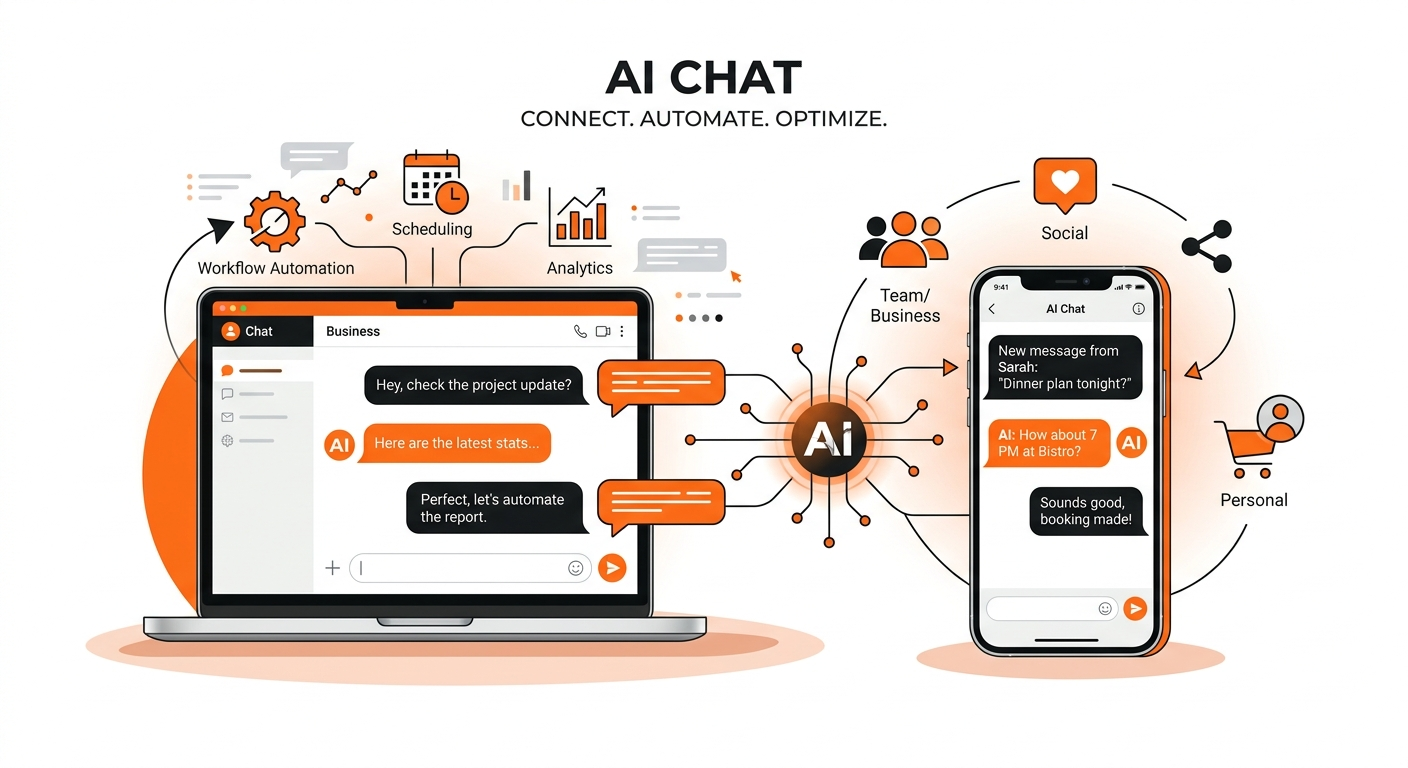
Instead of building a bot from scratch, a business owner uploads their data, sets conversation flows, and deploys an assistant that can answer questions, book appointments, qualify leads, and follow up across voice, chat, WhatsApp, and more.
The "no-code" part matters because it removes the dependency on engineering teams. Even a sales manager or operations lead can configure the system directly.
Changes happen in a flash, not in sprints.
What Does "Automating Customer Conversations" Actually Mean?
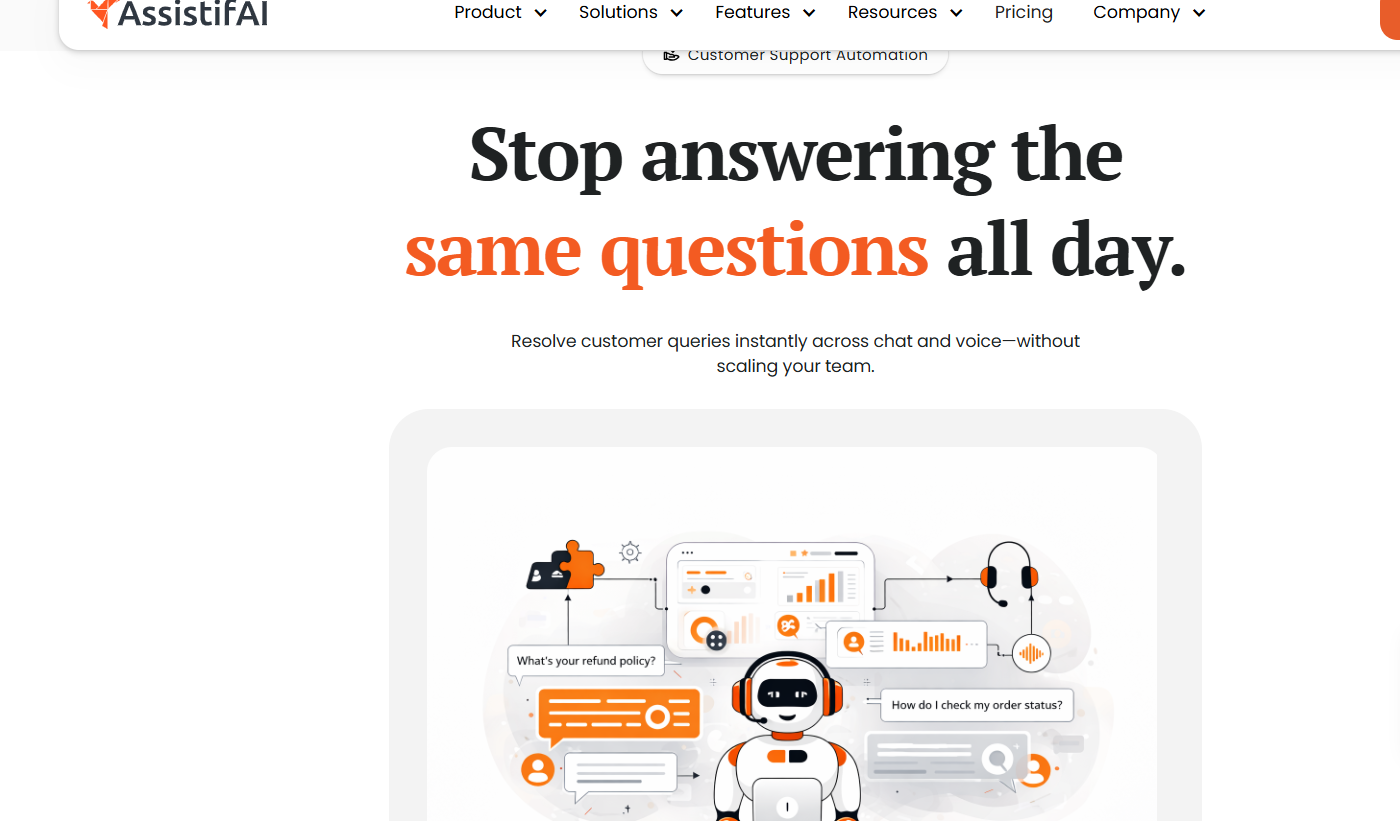
It means your business responds to every customer at any time through any channel, without the help of a human agent.
Here is what that looks like in practice:
- A customer calls at 9 PM. The AI answers, qualifies the lead, and books a callback for the next morning.
- A WhatsApp message comes in over the weekend. The assistant responds with relevant information and logs the interaction in your CRM.
- A lead fills out a form. A follow-up sequence triggers immediately. No one has to chase it, so no pressure or workload.
Automation does not replace the human relationship. It protects the window before that relationship starts.
What Actually Makes an AI Support Agent Work?
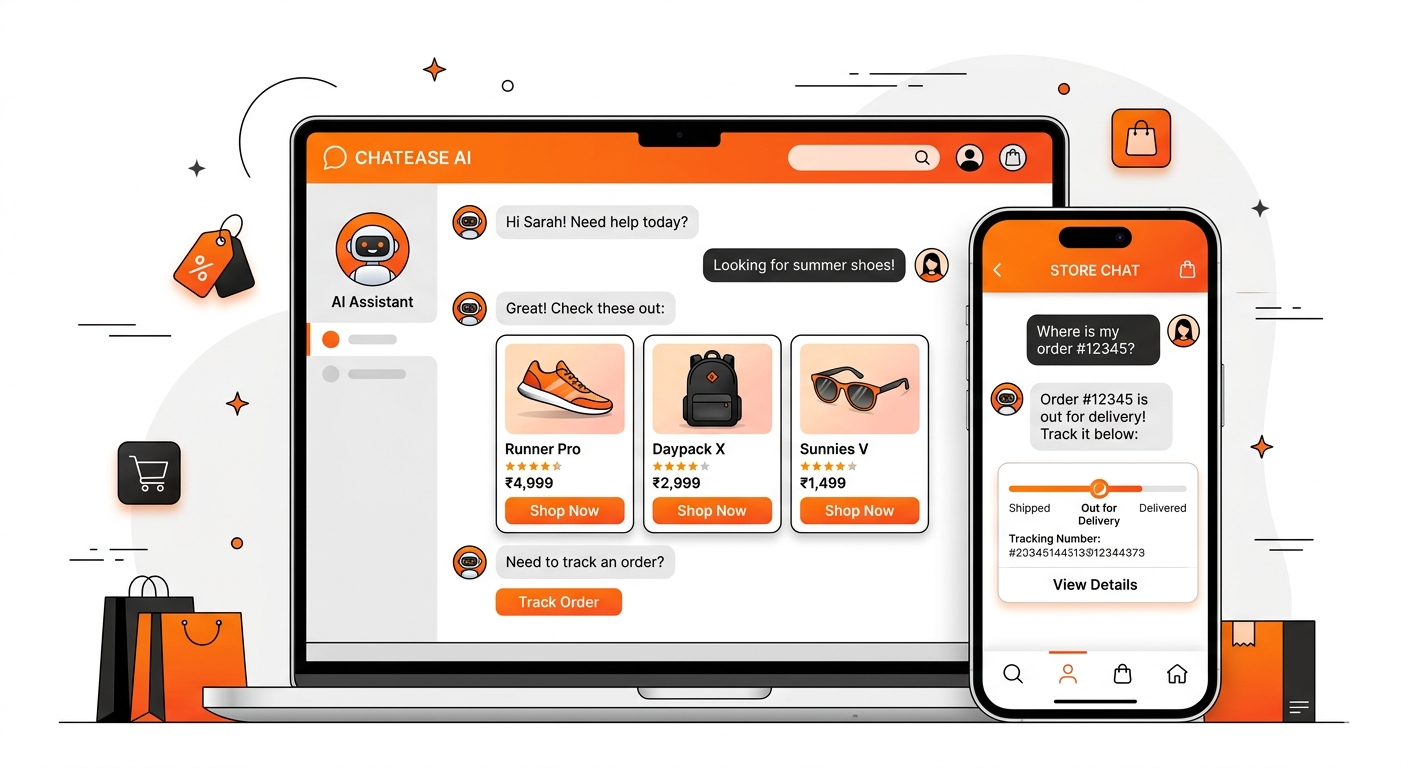
The best AI customer support agents do more than answer questions. They figure out what the customer is trying to do, pull information from different systems, and sometimes complete the task without human involvement. That sounds straightforward until you see how many moving parts are involved behind the scenes.
1. Natural language understanding (NLU)
Customers rarely explain problems cleanly. One person says, “Where’s my stuff?” Another writes a long complaint about a delayed shipment. A capable AI agent should recognize both as the same issue.
It also needs to handle typos, slang, and incomplete sentences. “can't login plz help” should trigger the same workflow as “I’m unable to access my account.” Many older bots still fail here because they rely too heavily on keyword matching rather than on actual intent. Strong systems also remember context during the conversation, so customers do not have to repeat order numbers or explain the same problem twice.
2. Knowledge management and retrieval
Traditional chatbots mostly send customers to FAQ pages. That usually creates frustration instead of solving the issue.
Modern AI agents search across help docs, internal knowledge bases, previous tickets, and product information to generate a direct answer. If someone asks why a video is not playing, the AI can combine troubleshooting steps from multiple sources into one clear response. Better systems also identify recurring questions and flag documentation gaps, helping support teams improve content over time rather than just reacting to tickets.
3. Task automation and execution
This is where AI support agents become genuinely useful. They do not just respond. They take action.
When connected to CRMs, billing systems, or order management platforms, the AI can process refunds, reset accounts, update customer details, or cancel subscriptions during the conversation itself. If a customer says, “Cancel my last order,” the ideal response is not “Please contact support.” The system should verify eligibility and complete the request immediately. That dramatically reduces resolution times, especially for repetitive support tasks.
4. Intelligent routing and escalation
Not every issue should be left to AI. Some situations are too technical, too sensitive, or too important to automate fully.
Modern AI agents recognize when a human should step in. They look at urgency, customer history, sentiment, and issue complexity before routing the conversation to the right person. More importantly, the handoff should feel seamless. Customers should not have to repeat the entire issue because the AI failed to transfer context properly.
5. Personalization and sentiment awareness
AI agents now adjust responses based on the customer and the situation. A frustrated returning customer should not receive the same response style as someone asking a simple pre-sales question.
Some systems can also detect frustration, confusion, or urgency during the conversation and adapt accordingly. That may mean simplifying responses, escalating faster, or changing tone. The goal is not to sound perfectly human. Most customers care more about getting accurate answers quickly, without having to repeat themselves.
What Do Businesses Actually Gain from No-Code AI Agent Platforms?
Every Call Gets Answered
A 2024 study by 411 Locals found that only 37.8% of incoming business calls are answered by a live person. The rest go to voicemail, and 85% of those callers never call back.
No-code AI platforms answer every call instantly, with zero hold time. For businesses running on inbound leads, for example, home services, legal, healthcare, and real estate, this alone changes the revenue picture.
Leads Stop Falling Through the Cracks
Speed matters more than most businesses realize. Research shows that 78% of customers buy from the first company that responds to their inquiry. A four-hour delay, even on the same day, is unacceptable.
AI agents respond in real time. They qualify leads during the conversation itself. High-intent prospects get routed immediately. Low-intent ones get nurtured. Nothing sits waiting in a queue.
Follow-Ups Happen Without Manual Effort
Most follow-ups fail because they depend on someone remembering to do them. Reps are busy, leads go cold, and deals that should have closed never do.
No-code AI platforms trigger follow-up sequences automatically based on what happened in the conversation. A missed call gets a callback trigger. A booked appointment gets a reminder sequence. A cold lead gets a re-engagement nudge after 48 hours. None of it needs a human to initiate it.
Manual Coordination Drops Significantly
Customer support teams in 2025 spend a significant portion of their day on repetitive tasks: answering the same questions, updating records, and chasing confirmations. AI-enabled workflows have reduced this kind of overhead for businesses that adopt them, with some teams reporting productivity gains of 15% to 30% in customer service functions (Masterofcode, 2026).
The time saved goes toward work that actually requires judgment.
Visibility Across the Customer Journey
Fragmented tools create blind spots. When calls, chats, and follow-ups live in different systems, nobody has a complete picture of what is happening to a lead.
No-code AI platforms centralize the conversation data. You see where leads drop off. You see what converts. You get alerts when a high-value interaction stalls. That visibility changes how operations leaders make decisions.
How Do No-Code AI Agent Platforms Compare to Traditional Chatbots?
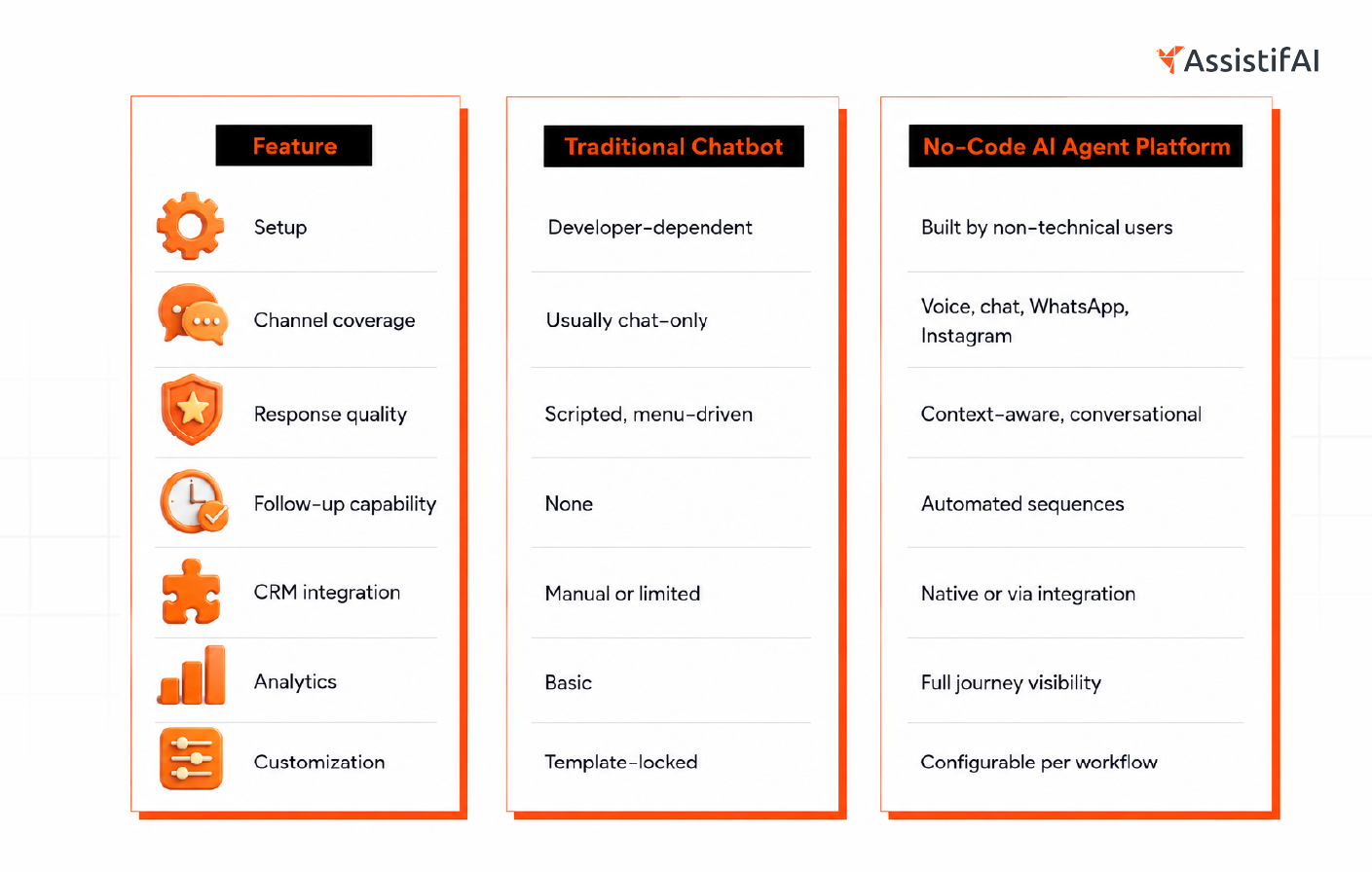
Traditional chatbots handle surface-level FAQs. On the other hand, No-code AI agent platforms handle actual workflows from first contact to conversion.
Who Should Be Using These Platforms?
These platforms are built for businesses where conversations drive revenue. If you are losing customers at the response stage, this tool category exists to fix that.
SMB owners and founders who cannot staff 24/7 coverage but still need to respond as they can.
Operations and customer support leaders who spend too much time manually coordinating follow-ups.
Non-technical decision-makers who want AI capabilities without waiting months for engineering resources.
The no-code promise is real here. Setup on modern platforms takes minutes, not months. One platform, AssistifAI, generates a functional assistant from a website scan in approximately 60 seconds, covering common queries and appointment booking before any manual configuration.
What Are the Common Mistakes When Choosing an AI Chatbot Automation Platform?
Choosing Voice-Only When You Need Execution
Some platforms handle calls well, but stop there. Your leads are also coming in via WhatsApp, web chat, and Instagram. A platform that only covers one channel leaves the others unmanaged.
Look for omnichannel coverage rather than just the one channel that feels most urgent today.
Prioritizing Speed Over Depth
No-code setup in 60 seconds is valuable. But if the platform cannot handle real workflows like inventory checks, custom integrations, and routing logic, you will hit a ceiling fast.
Templates get you started. Real business use cases need flexibility.
Ignoring Follow-Up as a Feature
Most businesses evaluate AI platforms on how well they handle inbound conversations. Very few ask: what happens after the conversation ends?
Follow-up is where most revenue is either captured or lost. Make sure your platform treats it as a core capability, not an add-on.
Treating It as a Set-and-Forget Tool
AI agents need refinement. Conversations reveal gaps in the assistant's responses. Workflows need to be adjusted as business priorities shift. Platforms that offer ongoing support and optimization deliver better outcomes than those that hand you a dashboard and walk away.
How Do You Choose the Right No-Code AI Agent Platform?
Start with the outcome you are trying to fix, not the feature list. Then ask these questions:
Does it reach all the channels your customers use? If your leads come in via WhatsApp and phone, a chat-only tool is a mismatch.
Can it handle your actual workflows? Demo with a real use case, not a generic script. See what happens when the conversation goes off-template.
What does post-onboarding support look like? Most platforms leave you after setup. The ones worth using stay involved.
Is the analytics layer useful or decorative? You need to see where leads drop, what converts, and what fails, not just a call volume count.
Can a non-technical person manage it day-to-day? If every change requires a developer, the platform is simply saying that it’s no-code. Better avoid.
The Bottom Line
The cost of slow response and missed follow-up is not abstract. It is $126,000 a year for an average small business vanishing call by call, message by message.
No-code AI agent platforms exist to stop that. They are not a replacement for human relationships. Consider it the system that ensures those relationships actually get a chance to start.
If you want to see how a unified AI platform handles conversations, follow-up, and workflows in one place, AssistifAI is built exactly for that.
Explore AssistifAI and see how it works
FAQs
What is a no-code AI agent platform?
A no-code AI agent platform is a tool that lets non-technical users build and deploy AI-powered assistants that handle customer conversations across voice, chat, and messaging without writing any code. Users configure the assistant using visual interfaces and their own business data.
How does automating customer conversations affect lead conversion?
Speed is the primary driver. Research shows that 78% of customers buy from the first company that responds. AI agents respond in real time, qualify leads during the conversation, and automatically trigger follow-ups so no lead sits idle while a team member is busy or offline.
Are no-code AI agent platforms suitable for small businesses?
Yes, and in many ways, they are better suited for SMBs than for enterprises. Small teams cannot staff 24/7 phone coverage, but AI agents can. The no-code setup also means there is no need to hire a developer or wait for engineering resources.
What is the difference between an AI chatbot and an AI agent?
A chatbot responds to questions. It’s an answering machine. An AI agent executes workflows. A chatbot tells a customer that an appointment is available. An AI agent books the appointment, sends a confirmation, sets a reminder, and logs the interaction all within the same conversation.
How long does it take to set up a no-code AI agent?
Setup time varies by platform. Basic assistants can be live in under an hour on modern platforms. Custom workflows like CRM integrations, inventory systems, or specific routing logic take longer and are typically built in partnership with the platform team.
What should I look for in an AI chatbot automation platform for customer support?
Look for omnichannel coverage, real follow-up automation, CRM integration, and a visibility layer that shows you what is happening across the customer journey. Avoid platforms that stop at conversation handling and treat everything after the call as someone else's problem.

Read More Blogs

Your next hire isn't human.


AssistifAI automates your workflows and delivers exceptional voice and chat-based customer support helping your business grow faster, save time, impress clients, and stay ahead of the competition.