

AI WhatsApp Chatbot for Business: Automate Customer Conversations on Your Most-Used Channel
TL;DR:
Problem: Most businesses are losing leads and burning team hours because they rely on manual replies on WhatsApp, a channel where 2 billion people expect an instant response.
Shift: AI WhatsApp chatbot automation fixes the response lag, handles repetitive queries without human input, and captures leads around the clock. The shift is not about replacing your team. It is about making sure no conversation goes unnoticed.
Fix: AssistifAI fixes this issue by connecting the same AI across WhatsApp, your website, and phone so no lead slips through, regardless of how or when they reach out.
Why WhatsApp is now a Core Business Channel?
WhatsApp has 2 billion active users globally. For businesses in South Asia, the Middle East, Latin America, and beyond, it has replaced email as the default channel customers use to reach out. According to Meta, over 175 million people message a WhatsApp Business account every day.
The problem is not the channel. The problem is what happens after a customer sends that first message. Most businesses respond late, miss messages entirely outside office hours, or burn team time answering the same five questions all day.
When a customer messages you at 9 PM expecting an answer, a reply at 10 AM the next day is not a response.
It is a missed sale!
Why are Businesses Still Losing Customers on WhatsApp?
The gap between customer expectation and business reality on WhatsApp comes down to four friction points that show up in almost every SMB or growing team:
- Repetitive queries eating up agent time: Pricing, hours, order status, FAQs, your team answers the same questions dozens of times a day.
- Slow response times are pushing customers away: A one-hour delay on WhatsApp feels like a day's wait. Customers move on.
- Missed leads outside business hours: A prospect messages at midnight. Nobody replies. They sign up with a competitor by morning.
- Manual workload that does not scale: As volume grows, you either hire more people or watch quality drop. Neither is a good option.
These are not edge cases. They are the normal operating realities for most businesses that manually run WhatsApp.
What does a WhatsApp AI Integration Actually Do?
A WhatsApp AI integration connects an AI-powered chatbot to your WhatsApp Business account via the official Meta API. The bot reads incoming messages, understands intent, and responds in natural language without a human in the loop.
It is not a simple decision tree that breaks the moment a customer goes off-script. A well-built AI WhatsApp chatbot understands context, remembers what was said earlier in the conversation, and handles follow-up questions without starting over.
What it can handle out of the box:
- Answering FAQs with accurate, business-specific responses.
- Qualifying leads by asking the right questions before routing to sales.
- Booking appointments and sending confirmations.
- Collecting feedback or survey responses.
- Triggering follow-up messages based on user actions.
What are the Real Benefits of an AI WhatsApp Chatbot?
The headline benefit is, of course, speed. An AI WhatsApp chatbot responds in under a second, every time, at any hour. But the real ROI goes deeper than just fast replies.
Does it Actually Reduce Workload?
Yes, it’ll. Teams using AI chat automation report handling 60–80% of incoming queries without any human involvement, according to industry benchmarks. That is not a minor efficiency gain. It means your support team focuses on complex issues that actually need a human decision.
Does it Help With After-Hours Lead Capture?
This is where most businesses leave money on the table. A prospect who reaches out at 11 PM and gets no answer until the next morning has often already moved on. An AI chatbot captures their details, answers initial questions, and keeps the conversation warm until your team is back online.
Does it Improve Customer Experience?
Customers do not care whether they are talking to an AI or a human. Instead, they care only about whether they get a useful answer immediately. An AI WhatsApp chatbot delivers consistent, accurate responses without the variation that comes when different team members answer the same question differently.
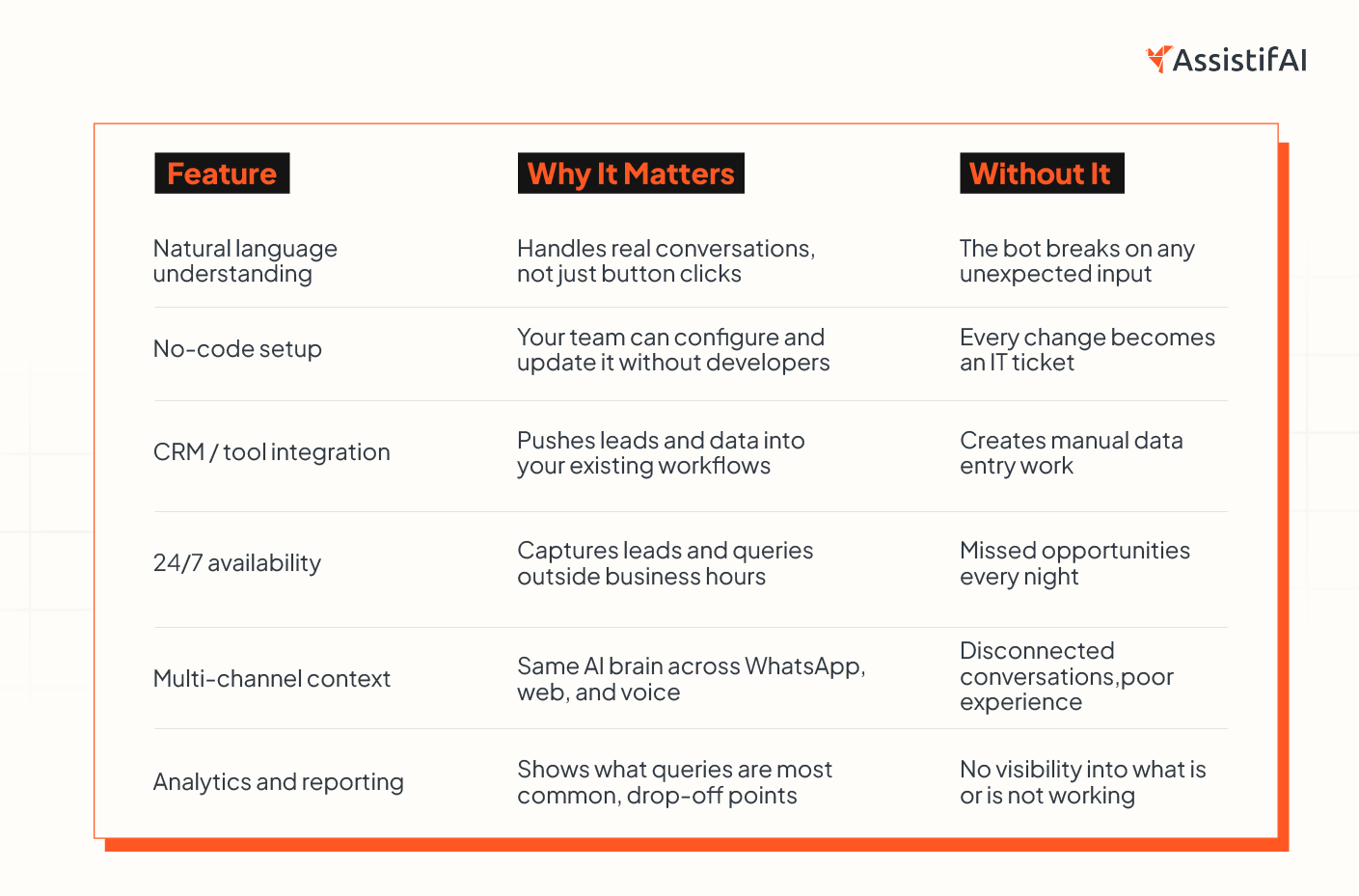
What Features Should You Look for in a WhatsApp Chatbot?
Not all WhatsApp chatbot tools are equal. Here is what separates a useful tool from one you will abandon in three months:
How Do You Implement a WhatsApp Chatbot Without Technical Chaos?
The actual setup process is simpler than most businesses expect if you pick the right tool. Here is how it works in practice:
- Connect to the WhatsApp Business API: Done through an official Meta Business Partner or a platform that handles API access for you.
- Train the AI on your business data: Upload your FAQs, product details, pricing, and common queries. The AI uses this as its knowledge base.
- Design your conversation flows: Map out the common paths like inquiry, lead capture, booking, and complaint. Keep flows short and outcome-focused.
- Integrate with your existing tools: Connect to your CRM, calendar, or helpdesk so conversations feed into your actual workflow.
- Test with real scenarios: Run through the queries your team handles most often. Adjust responses where needed.
- Go live and monitor: Track drop-off points and unanswered queries in the first two weeks. This is where you find the gaps.
The most common mistake here is spending too long on setup and not enough time testing with real customer language. Your customers do not talk the way your internal documentation is written.
How Does AssistifAI Take WhatsApp Automation Further?
Most WhatsApp chatbot tools stop at web chat and messaging. AssistifAI goes further by connecting the same AI across WhatsApp, your website, and traditional phone operations, both inbound and outbound, without any coding or technical setup.
A business can handle 10 or 10,000 simultaneous interactions without hiring, training, or changing infrastructure. The AI that answers a WhatsApp query at 2 AM is the same one that runs outbound appointment reminders (which reduce no-shows by up to 60%), collects survey responses, and follows up on cold leads, all of which share the same conversation context.
For SMBs and growing teams that need to scale customer interactions without scaling headcount, AssistifAI's chat assistant offers a practical entry point with no credit card required to get started.
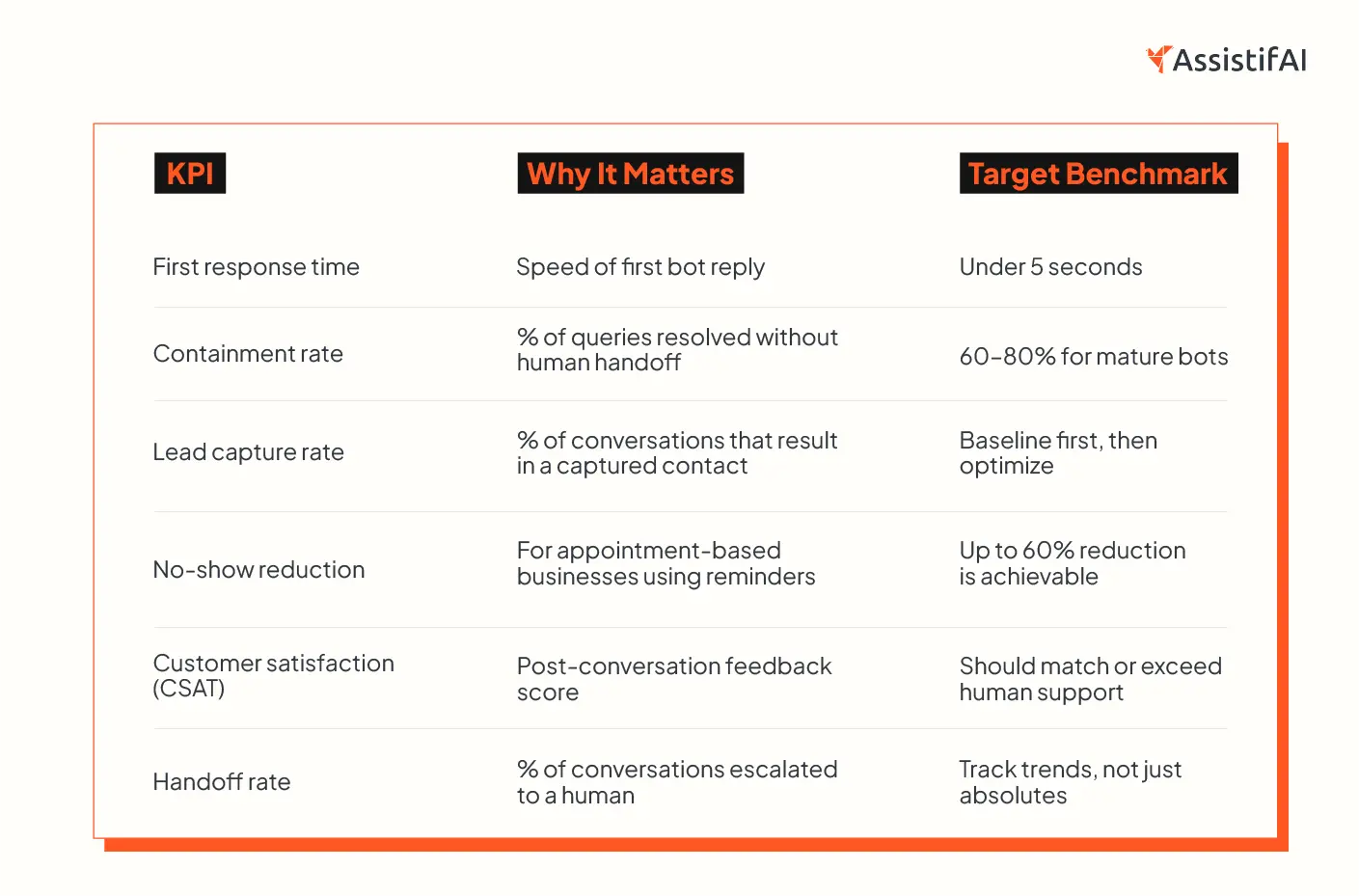
How Do You Measure if Your WhatsApp Chatbot is Actually Working?
Set these KPIs before launch, not after. Otherwise, you will not know what good looks like.
The Bottom Line
WhatsApp is already where your customers are. The only question is whether you show up with a response or leave them waiting.
An AI WhatsApp chatbot fixes the three most common failure points: slow responses, missed after-hours leads, and repetitive manual work without requiring a bigger team or a complex technical rollout.
If you want to see what this looks like in practice, AssistifAI is the pick of the bunch.
No coding. No credit card. Set up in minutes.
FAQs
Is an AI WhatsApp chatbot suitable for small businesses?
Yes. Small businesses benefit more because they have fewer team members to handle incoming volume. A chatbot handles the routine load: FAQs, lead capture, booking so your small team can focus on work that actually requires human judgment.
How is an AI WhatsApp chatbot different from a basic auto-reply?
Auto-replies send the same canned message to everyone. An AI WhatsApp chatbot reads the customer's actual message, understands what they are asking, and gives a relevant response. It can ask follow-up questions, qualify leads, and hand off to a human when the situation calls for it.
Does WhatsApp AI integration require a developer to set up?
Not with the right platform. Tools like AssistifAI are built for non-technical users. You configure the bot using your business information, test it, and deploy without writing a single line of code.
What is the best AI chatbot for WhatsApp if I also need phone automation?
Look for a platform that supports both channels through a single AI layer. AssistifAI covers WhatsApp, web chat, and inbound/outbound phone calls using the same AI brain, so conversation context is not lost when a customer switches channels.
Can a WhatsApp chatbot handle multiple languages?
Most AI-powered WhatsApp bots detect and respond in the customer's language, commonly English, Arabic, Spanish, Hindi, and Portuguese. Check your platform's language support if multilingual coverage is critical for your market.
What happens when the bot cannot answer a question?
A well-configured bot escalates gracefully. It tells the customer it is passing them to a human, captures their details, and either notifies your team or schedules a callback. The worst outcome is a bot that goes silent or gives a wrong answer, which is why testing matters more than setup speed.

Read More Blogs

Your next hire isn't human.


AssistifAI automates your workflows and delivers exceptional voice and chat-based customer support helping your business grow faster, save time, impress clients, and stay ahead of the competition.