
AI Scheduling for Healthcare Clinics: How Multi-Location Practices Are Automating Bookings, Waitlists, and Patient Follow-Ups
Clinics that operate across three locations are not three times as complex as a single-location practice. They are ten times harder to coordinate. Scheduling breaks first.
A 2022 report by Accenture found that 77% of patients say the ability to book, change, or cancel appointments online is important when choosing a provider. Most multi-location practices still rely on front-desk teams to field calls, manually check provider calendars, and send follow-up messages one at a time. That system worked when the clinic had one location and two providers. It does not work at scale.
AI scheduling for clinics replaces that manual layer. It captures booking requests 24/7, routes patients to the right provider and location, fills waitlist cancellations before the slot expires, and automatically runs follow-up communication. The front desk stops managing volume and starts handling what actually needs human judgment.
This blog post covers how AI scheduling works in practice, what it solves for multi-location clinics, and what to look for before choosing a platform.
TL;DR
Manual scheduling breaks at scale. When a clinic operates across multiple locations, the cost of a missed call, a cancellation without a waitlist fill, or a skipped follow-up adds up fast. AI scheduling for clinics removes those gaps by handling bookings 24/7, automatically filling open slots, and running follow-up communications without staff involvement. The result is fewer no-shows, more booked appointments, and front desk teams focused on patients in the room.
Why Scheduling Breaks as Healthcare Practices Grow
As healthcare practices expand, scheduling becomes one of the first operational processes to show strain. What works for a single clinic often breaks down when multiple locations, providers, and patient communication channels must be managed simultaneously. Front desk teams spend more time coordinating calendars, handling reschedules, managing cancellations, and responding to booking requests.
As appointment volumes increase, missed calls, unfilled slots, and delayed follow-ups become more common. The challenge is no longer finding staff to handle scheduling. It is building a system that can manage growing complexity without creating bottlenecks that affect patient access, provider utilization, and revenue.
AI scheduling for clinics automates appointment booking, waitlist management, and patient follow-up without requiring staff to manage each interaction. It works by connecting to your calendar, provider schedules, and communication channels, then handling requests in real time.
A patient calls after hours. Instead of hitting voicemail, they book an appointment via voice or chat, receive a confirmation, and receive automatic reminders. No front desk headaches.
What Are the Challenges of Manual Scheduling?
Manual scheduling puts a ceiling on how many patients a clinic can serve. Every booking that requires a staff member to pick up the phone, check a calendar, send a confirmation, and follow up manually is not scalable.
The friction shows up in four places:
- Repetitive booking tasks keep front desk staff occupied with work that offers no clinical value
- Missed calls convert directly into missed appointments; a patient who gets voicemail books elsewhere
- Response delays during peak hours mean booking windows close before staff can respond
- Manual follow-up for reminders, recalls, and post-visit communication consumes hours that front desk teams do not have
According to Accenture, 68% of patients say they would switch providers for a better scheduling experience. The cost of a poor system is patient attrition, not just inconvenience.
How Does AI Automate Appointment Booking?
AI appointment booking works by intercepting patient requests across every channel and resolving them without requiring a staff member to act. The system checks provider availability, matches the patient to the right location and time, confirms the booking, and logs it into the calendar.
The core functions:
- 24/7 request capture across voice, chat, WhatsApp, and web without wait times or voicemail
- Provider and location matching based on patient preference, availability, and service type
- Automated confirmations sent immediately after booking across the patient's preferred channel
- Scheduling workload reduction so front desk teams handle exceptions, not volume
The practical outcome is that a clinic captures booking intent the moment it exists, rather than when a staff member becomes available.
How Does AI Handle Cancellations, Reschedules, and Waitlists?
An unfilled cancellation is a revenue loss. Most clinics do not have a fast enough process to identify the cancellation, check the waitlist, contact a waitlisted patient, confirm their availability, and update the calendar before the slot expires. AI does this in seconds.
The process runs automatically:
- Cancellation detection triggers the moment a patient cancels through any channel
- Waitlist matching identifies the next eligible patient based on provider, location, and time preference
- Real-time notification is sent to the waitlisted patient with a confirmation option
- Calendar update reflects the new booking instantly, keeping provider schedules optimized
This turns a revenue leak into a filled slot without any staff coordination.
How Does AI Improve Patient Follow-Ups?
Patient follow-up is the part of clinic operations that breaks down most often under manual systems. Reminders are sent inconsistently. Post-visit messages do not go out. Recall campaigns are deprioritized when staff are overloaded.
AI follows up on a schedule that the clinic sets once:
- Appointment reminders are sent at defined intervals (48 hours, 24 hours, same day) across SMS, email, or WhatsApp
- Post-visit communication delivers care instructions, satisfaction surveys, or next-step guidance automatically
- Recall campaigns re-engage patients due for annual checkups, specialist referrals, or follow-up visits without manual outreach
- Consistent engagement across every patient, every location, every time
The result is a patient communication layer that runs regardless of whether the front desk is busy.
How Does Patient Routing Work Across Multiple Locations?
Routing is where most multi-location practices lose efficiency. A patient calls the main number and gets transferred twice before reaching the right location. AI routing removes those transfers.
The system qualifies the patient during the initial interaction:
- Service type needed
- Location preference or nearest site
- Provider preference
- Available appointment windows
It then books them at the correct location without requiring staff to relay information between sites. A patient seeking a dermatology appointment at the nearest clinic is matched and booked in a single interaction.
How Does AI-Powered Waitlist Automation Help Fill Empty Appointment Slots?
Every clinic has a waitlist. Most clinics do not use it well. The gap between a cancellation and a filled slot is usually handled manually, which takes too long to complete before the time window closes.
How Does AI Identify Available Slots Automatically?
The system monitors the schedule continuously. When a cancellation happens, it does not wait for a staff member to notice. It triggers the fill process the moment the slot opens.
The identification process covers:
- Real-time cancellation detection across all booking channels
- Slot duration and provider matching to find eligible waitlist candidates
- Location and availability filtering to ensure the match is logistically valid
- Calendar lock to prevent double-booking while the offer is being confirmed
How Are Waitlisted Patients Notified Instantly?
Notification speed determines fill rate. A waitlisted patient who receives an offer within minutes of a cancellation is far more likely to accept than one who receives a call the next morning.
AI sends the notification immediately via:
- SMS with a one-tap confirmation option
- WhatsApp message with appointment details and a confirm/decline response
- Automated voice call for patients who prefer phone contact
If the first patient declines, the system moves to the next candidate without staff involvement.
How Does Waitlist Automation Reduce Revenue Loss From Cancellations?
The math is direct. A clinic with 20 providers, each seeing 15 patients per day, at an average visit value of $150, loses $3,000 for every 1% increase in unfilled cancellations. A system that fills those slots consistently converts a structural revenue leak into a recoverable loss.
Waitlist automation addresses three levers:
- Fill speed reduces the window between cancellation and rebooking
- Candidate reach ensures every eligible waitlisted patient is contacted, not just the ones a staff member remembers to call
- Confirmation efficiency removes the back-and-forth of manual booking from a cold call
How Are Clinics Automating Patient Follow-Ups?
Patient follow-up is as much a retention tool as a scheduling function. Clinics that communicate consistently between visits see higher rebooking rates, lower no-shows, and stronger patient satisfaction scores.
How Do Appointment Confirmations and Reminders Reduce No-Shows?
No-shows cost U.S. healthcare providers an estimated $150 billion annually, according to a report cited by the National Center for Biotechnology Information. The primary driver is patients who forget, not patients who choose to miss.
Automated reminders address this directly:
- A confirmation sent immediately after booking sets the appointment in the patient's awareness
- A 48-hour reminder gives enough time for rescheduling if needed
- A day-of reminder reduces last-minute no-shows without requiring a staff member to make the call
The reminder sequence runs automatically based on the clinic's configured timeline.
What Should Post-Visit Follow-Up Messages Include?
Post-visit follow-up is the most underdeveloped part of patient communication in most clinics. Sending a message after a visit does three things: it reinforces care compliance, it captures satisfaction feedback, and it creates a natural opening for the next booking.
Effective post-visit messages include:
- Care instructions or next steps tied to the specific visit type
- A satisfaction survey link (short, one to two questions)
- A prompt to book the next appointment, where clinically appropriate
The key is relevance. A generic "thank you for your visit" message is noise. A message that references the visit type and provides a clear next step is useful.
How Do Recall Campaigns Bring Patients Back?
Recall campaigns target patients who are due for a return visit but have not booked one. This is especially high-value for annual checkups, specialist follow-ups, and chronic condition management.
The campaign runs on criteria the clinic defines:
- Time since last visit (e.g., 11 months for annual patients)
- Visit type (e.g., patients seen for a specific service who have not returned)
- Engagement status (e.g., patients who confirmed but did not rebook)
AI automatically sends outreach and routes responses to bookings without staff involvement.
How Does Automated Communication Reduce No-Shows?
Consistent communication creates a patient expectation of follow-through. When patients receive a reminder, a confirmation, and a day-of message, the appointment becomes a confirmed event in their routine rather than a tentative item on a list.
The no-show reduction comes from three points:
- Early reminders surface scheduling conflicts while there is still time to rebook and fill the slot
- Easy rescheduling options in the reminder message reduce silent no-shows
- Consistent follow-up builds the habit of responding to clinic communications
What Should Healthcare Clinics Look for in an AI Scheduling Solution?
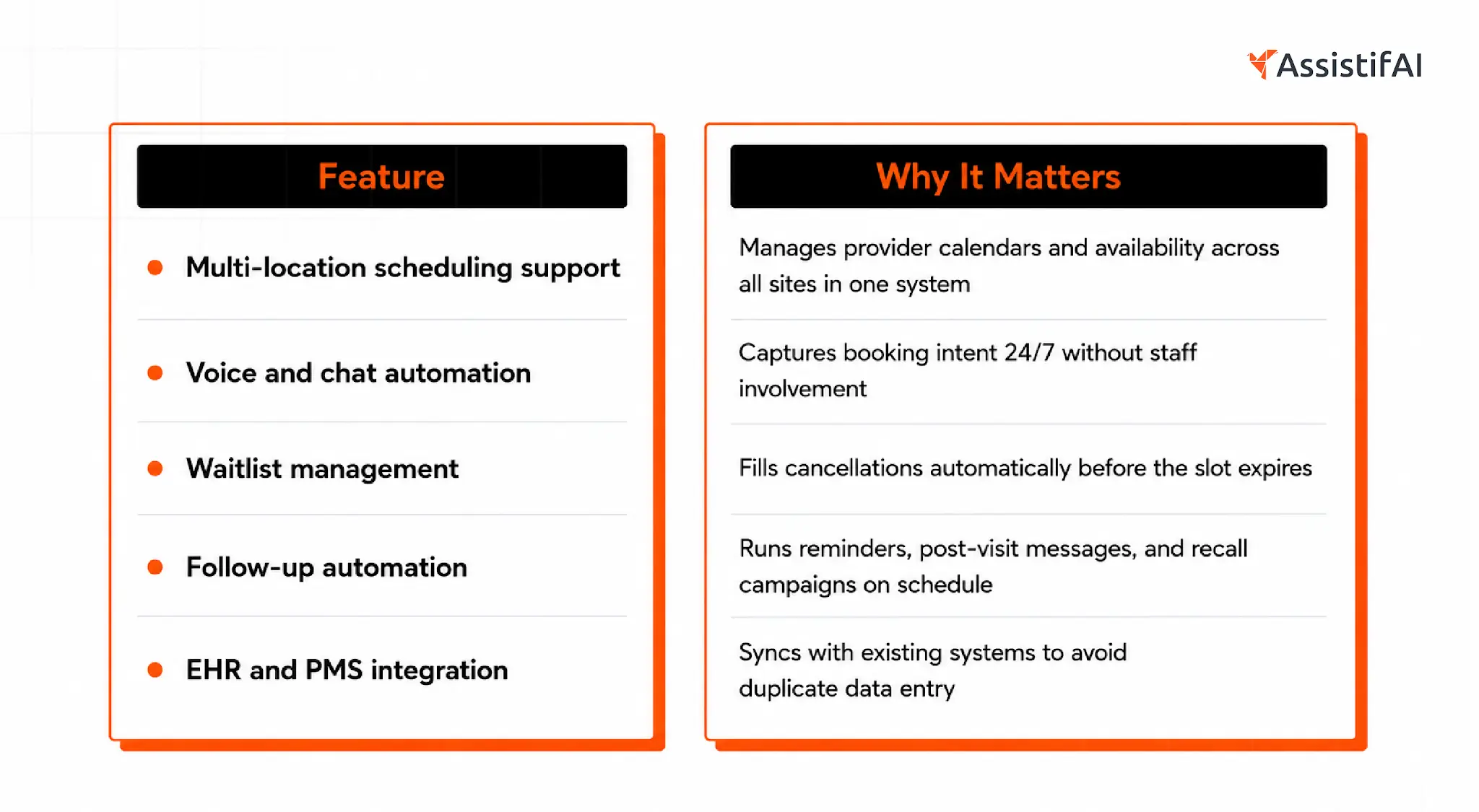
Not every AI scheduling tool is built for the complexity of multi-location clinical operations. A solution designed for a single-location business will break down under the demands of routing, provider management, and communication volume in a growing practice.
Does the Solution Support Multi-Location Scheduling?
A single-location scheduling tool cannot manage the routing, provider coordination, and calendar synchronization demands of a multi-site practice. The solution needs to treat all locations as a single connected system, rather than separate calendars that require manual reconciliation.
Look for:
- Centralized availability view across all locations
- Automated routing logic based on service type and location
- Provider-level schedule management within the shared system
Does It Handle Voice and Chat Appointment Automation?
Voice remains the primary booking channel for most healthcare patients. A solution that only handles web chat or SMS will miss the majority of inbound booking intent. The AI needs to handle a full conversation, answer scheduling questions, and confirm bookings via phone call, not just via text exchange.
Key requirements:
- Conversational voice AI that handles natural language booking requests
- Seamless escalation to a human agent for complex cases
- Consistent booking logic across voice, chat, and messaging channels
Does It Include Waitlist Management?
Waitlist management is not a bonus feature. In a high-volume clinic, it is a revenue protection mechanism. The system should process cancellations in real time without staff involvement, with confirmation logic that prevents double-booking.
Does It Automate Follow-Up Communication?
Follow-up automation needs to be configurable by visit type, location, and patient segment. A system that sends the same message to every patient is better than nothing, but one that sends relevant, visit-specific communication drives rebooking rates.
Does It Integrate With Existing Healthcare Systems?
A scheduling tool that operates in isolation creates a parallel data problem. Every booking, cancellation, and follow-up needs to sync with the clinic's existing EHR or practice management system (PMS) to maintain a single source of truth for patient records.
How Does AssistifAI Help Multi-Location Clinics Automate Scheduling and Patient Communication?
AssistifAI is an AI workforce platform built to replace fragmented tool stacks with one system that handles conversations, follow-ups, and workflows. For multi-location clinics, that means a single platform managing booking, waitlist filling, and patient communication across every site and every channel.
How Does AssistifAI Handle AI-Powered Appointment Booking?
AssistifAI deploys conversational AI to handle booking requests via voice, chat, WhatsApp, and web. A patient can call the clinic after hours, speak with the AI, and leave with a confirmed appointment. No voicemail. No callbacks required.
The system matches patients to the right provider and location based on availability and preference, confirms the booking immediately, and logs it without staff involvement.
How Does AssistifAI Manage Automated Waitlists?

When a cancellation occurs, AssistifAI identifies the open slot, checks the waitlist, and immediately notifies the next eligible patient. The patient can confirm with one tap. The calendar updates automatically.
No staff member needs to monitor the cancellation queue or make follow-up calls to fill slots.
How Does AssistifAI Handle Intelligent Patient Follow-Ups?
AssistifAI runs follow-up communication on a schedule configured by the clinic once. Appointment reminders go out at the right intervals. Post-visit messages are sent with content relevant to the visit type. Recall campaigns run automatically for patients due for a return visit.
The follow-up layer works across voice, SMS, WhatsApp, and chat, so patients receive communication on the channel they actually use.
Does AssistifAI Provide 24/7 Voice and Chat Support?
Yes. AssistifAI handles inbound calls and messages around the clock. A patient who tries to book at 10 PM reaches a system that can complete the booking, not a voicemail that adds friction and delays the conversion.
Voice is core to the platform, not an add-on. The AI handles natural language booking conversations, answers scheduling questions, and escalates to a human agent when needed.
How Does AssistifAI Maintain Consistent Scheduling Across Every Location?
Every location runs on the same system. Provider calendars, availability windows, and booking logic are managed centrally. A patient calling any location reaches the same intelligent booking experience, routed correctly based on their need and the clinic's configuration.
There are no location-specific tools to reconcile. No calendar exports to manage manually. One platform. All locations.
Conclusion
Why Is AI Scheduling Becoming Essential for Growing Healthcare Practices?
Manual scheduling is a constraint that gets more expensive as the practice grows. Every missed call is a missed booking. Every unfilled cancellation is lost revenue. Every skipped follow-up is a patient who does not return. At one location, these are manageable. At three, five, or ten locations, they compound into a structural problem.
AI scheduling for clinics systematically removes these gaps. Bookings are captured 24/7. Cancellations are filled before the slot expires. Follow-up communication runs on schedule without staff involvement. The practice grows without the administrative overhead growing at the same rate.
What Is the Next Step Towards Smarter Clinic Operations?
The first step is to identify where the current system breaks down. For most multi-location practices, it is one of three places: booking volume during peak hours, cancellation fill rate, or follow-up consistency. AI scheduling addresses all three from one platform.
AssistifAI gives multi-location clinics the tools to automate those gaps without replacing existing systems or requiring technical resources to set up. If your practice is losing appointments to missed calls, unfilled waitlists, or inconsistent follow-ups, the system is the problem. AssistifAI fixes the system.
FAQ
What is AI scheduling for healthcare clinics?
AI scheduling for clinics is an automated system that handles appointment booking, waitlist management, and patient follow-up communication without requiring staff to manage each interaction. It works across voice, chat, and messaging channels to capture booking intent 24/7, route patients to the right provider and location, and run follow-up communication on a defined schedule.
How does AI scheduling reduce no-shows?
AI scheduling reduces no-shows by sending automated appointment reminders at multiple points before the visit: at booking confirmation, 48 hours before the appointment, and on the day of the appointment. Early reminders also surface scheduling conflicts when there is still time to rebook and fill the slot with a waitlisted patient, thereby protecting both patient attendance and clinic revenue.
Can AI scheduling work across multiple clinic locations?
Yes. AI scheduling platforms designed for multi-location practices manage provider calendars, routing logic, and patient communication across all sites within a single system. Patients calling any location receive the same booking experience, routed correctly based on service type, provider availability, and location preference.
What happens to a canceled appointment when AI is managing the schedule?
When a patient cancels, the AI detects the open slot immediately and triggers the waitlist fill process. It identifies the next eligible waitlisted patient, sends a notification with a confirmation option, and updates the calendar automatically when the patient confirms. The entire process runs without staff involvement.
How does AI follow-up automation improve patient retention?
Automated follow-up keeps the clinic in contact with patients between visits through appointment reminders, post-visit messages, and recall campaigns. Consistent communication builds patient engagement, increases rebooking rates, and reduces the number of patients who fall out of care due to missed outreach rather than deliberate choice.
What should a multi-location clinic look for when choosing an AI scheduling platform?
A multi-location clinic needs a platform that supports centralized calendar management across all sites, natively handles voice and chat bookings, fills cancellations through automated waitlist logic, and integrates with the clinic's existing EHR or practice management system. The solution should also automatically run follow-up communications and provide visibility into scheduling performance across all locations.

Read More Blogs

Your next hire isn't human.


AssistifAI automates your workflows and delivers exceptional voice and chat-based customer support helping your business grow faster, save time, impress clients, and stay ahead of the competition.