

AI-Powered Voice Assistant: Real-World ROI, Integration Scenarios & Which Platform Wins for Your Business in 2026

TL;DR
Most businesses already have enough tools. What they lack is a system that can answer calls, qualify leads, trigger workflows, and follow up without human intervention. AI-powered voice assistants are now reducing missed opportunities, lowering support costs, and creating measurable operational ROI.
This blog explains where voice AI actually fits inside your workflows, what returns businesses are getting, and which platforms deliver beyond basic call handling.
Most businesses are not losing customers because calls go unanswered. They are losing them because follow-ups fall through the cracks, appointments are never logged, and support teams still rely on disconnected systems.
AI-powered voice assistants are now moving beyond “call answering” to become measurable, revenue-generating platforms that book appointments, qualify leads, update CRMs, and reduce operational workload in real time.
The challenge in 2026 is no longer whether voice AI works. It is the platform that integrates with your business workflows and delivers measurable ROI.
Why Are So Many Businesses Still Losing Money on Phone Calls?
Every missed call equals a missed sale. Every unread message is a lead that has moved on. And, every manual follow-up is a task your team does instead of something that matters.
Businesses hopelessly using separate tools for calls, CRM, follow-ups, and reporting are paying three times: in software costs, in coordination time, and in dropped opportunities. To compensate for this, businesses hire more employees, and the people stitching it together manually are your most expensive system.
Here is what the data shows:
- 80% of businesses expect to merge AI-driven voice technology into customer service by 2026.
- Voice agent usage grew 9x in 2025 alone.
- The market hit $22.5 billion.
This is no longer about a straight increase. It is about cutting costs and capturing revenue that is already walking through your door.
What Makes Voice AI Actually Worth the Investment?
Voice AI for business ROI is a smart choice when the platform goes beyond answering calls to execute what happens after the call ends. It manages follow-ups, bookings, CRM updates, and routing.
When most tools stop at the conversation, ROI lives in the execution.
The numbers don’t lie
- Per-call cost drops from $7–$12 (human) to $0.40–$1.00 (AI), according to IBM.
- Businesses handling 5,000 calls per month save $15,750–$24,500 monthly by routing 70% to an AI-powered voice assistant.
- Average handle time decreases by 25–50%, with first-time resolution surpassing 90%.
- Customer satisfaction with voice AI for business rose from 53% in 2022 to 72% in 2025 (Zendesk).
- A Forrester study found 391% ROI over three years with payback in under 3.5 months.
See the magical shift: Tasks that used to take an entire day are now finished in minutes.
The result? Teams can experiment more often and fail less, work less, all without burning out.
What drives the ROI gap between tools?
Most platforms report good metrics on inbound call handling. The gap shows up in three places:
- Follow-up completion rate: Does the system trigger callbacks, send reminders, and update your CRM, or does it stop at the call summary?
- Lead capture rate: Did a missed call at 11 PM turn into a booked appointment by 8 AM, or did that lead go cold?
- Visibility: Can you see where leads drop, what converts, and which workflows are breaking?
Platforms that only handle voice give you a transcript. Platforms that handle execution generate revenue for you.
Where Does an AI-Powered Voice Assistant Actually Fit in Your Workflow?
The highest-value integrations are not where you expect them. It is not just about replacing a receptionist. It is about removing every manual handoff between a conversation and a business outcome. A well-integrated AI-powered voice assistant ensures leads, follow-ups, and customer interactions move seamlessly through your systems, saving time, reducing errors, and boosting ROI.
Let’s dive in to see where we should place an AI-powered voice assistant in your workflow.
CRM Integration
An AI-powered voice assistant should write back to your CRM in real time, not via an export or a Zapier delay. When a lead qualifies on a call, that record should update instantly. If your platform requires a human to review and log the call, you have not automated anything. You have just moved the work.
Key friction point: Most teams discover their CRM data is incomplete because logging depends on rep discipline. Voice AI removes that dependency.
Helpdesk and Customer Support Platforms
AI handles 70% of routine inbound calls: order status, appointment changes, FAQ answers, payment processing, and account lookups (AdAI Research, March 2026). What requires careful integration is the handoff when the AI reaches its limit; the escalation to a human agent needs context, not a cold transfer.
Platforms that pass conversation context to your helpdesk agent save 4–6 minutes per escalation. At scale, that is the difference between a bloated support team and a lean one.
Scheduling and Booking Systems
This is where voice AI proves immediate ROI. A caller asks to book an appointment. The AI checks availability, confirms the slot, sends a reminder, and logs it without a human in the loop.
For medical clinics, legal offices, home services, and salons, this single integration replaces a full-time receptionist and eliminates double-bookings.
E-Commerce and Order Management
Voice AI handles order tracking, returns, and upsell prompts in real time. The missed opportunity here is not the query; it is the upsell. An AI that answers "where is my order" without asking "would you like to add X to your next order?" is simply a waste of money.
The Common Integration Mistake
Teams integrate voice AI at the top of the funnel (answering calls) and leave everything else manual. The workflow looks automated, but the CRM still needs updating, follow-ups are still getting missed, and the reporting still lives in a spreadsheet. If your tools do not share data automatically, you have not removed fragmentation; you have hidden it.
Voice Automation Platform Comparison: Which One Actually Delivers?
For a voice automation platform comparison, the right criteria to look for are not features but outcomes.
What percentage of your leads get followed up on? What percentage of your workflows are completed without human input? Features matter only if they produce these results.
What to evaluate before you choose
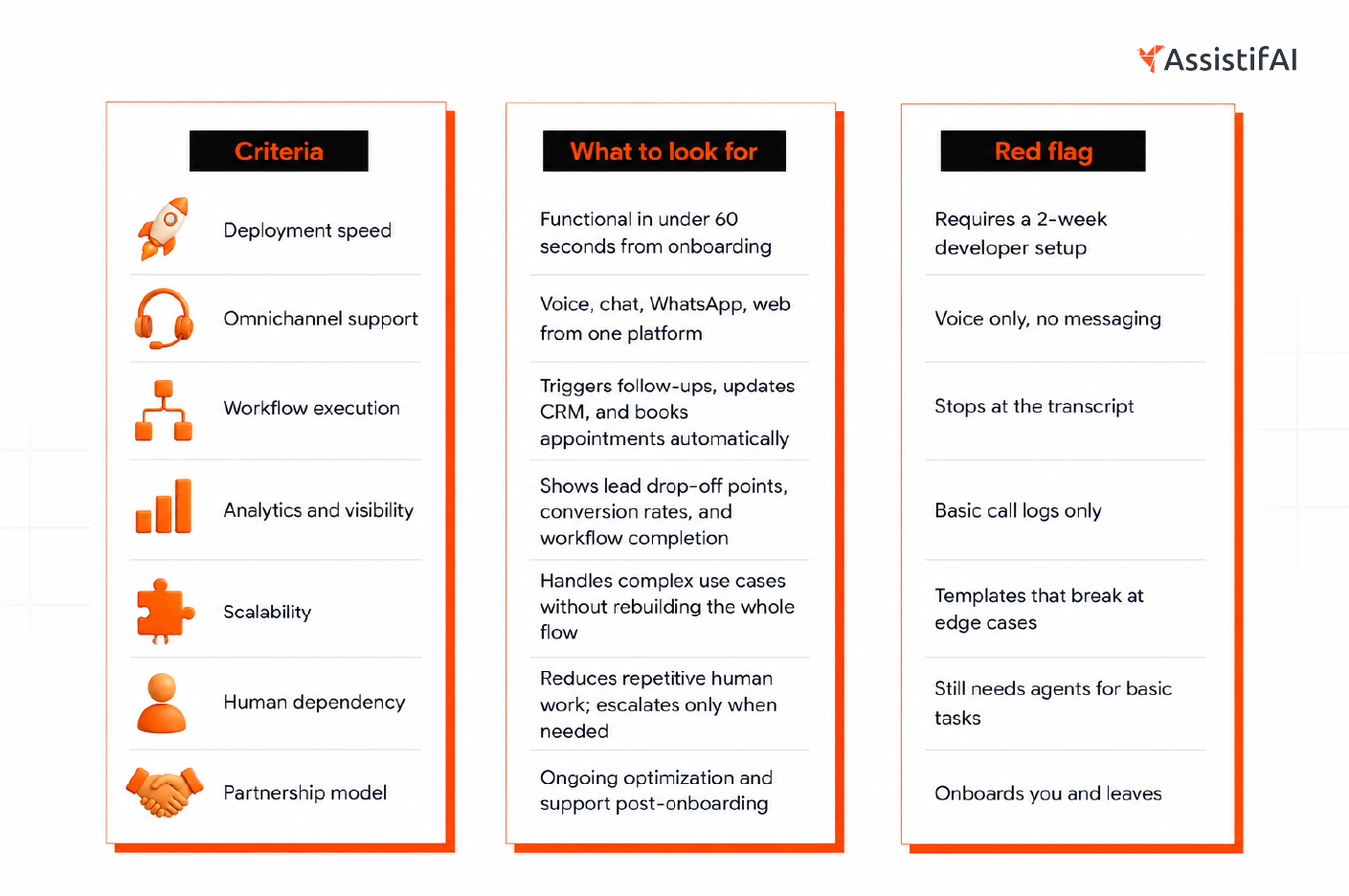
Platform Comparison: How the Leading Options Stack Up
Where most platforms break
Developer-heavy tools like Bland AI and Retell AI give you control, but only if you have engineers to build and maintain the flows. No-code tools like Synthflow get you started fast, but hit a ceiling the moment your use case goes beyond the template.
Hybrid models that mix AI with human agents keep costs high and scaling slow. The system is only as consistent as your agents.
AssistifAI sits in a different category. It is not just a voice bot. It is a platform that handles the full cycle, like conversation, follow-up, workflow, and visibility, without requiring a developer or a human agent for routine tasks.
How Are Businesses Actually Winning with AI Voice?
The biggest wins are not in call volume metrics. They are in what happens after the call, like faster qualification, automatic bookings, zero missed follow-ups, and full pipeline visibility.
Lead Qualification
An AI-powered voice assistant qualifies leads during the call, not after. It asks the right questions, scores the response, and routes high-intent callers to the right outcome in real time.
- Outcome: Lead qualification time drops from 48 hours (manual) to under 2 minutes
- Impact: Sales teams only touch qualified leads; pipeline quality improves
Customer Support Automation
A regional home services company handling 3,000 calls per month moved 70% of routine queries to AI voice.
The result: Support headcount stayed flat while call volume grew 40%.
- Outcome: $18,000+ monthly savings in support labor
- Customer satisfaction held at 74% because escalations were handled with full context
Appointment Booking
A multi-location medical clinic implemented voice AI for appointment scheduling. Calls after business hours were converted at 31% previously; those calls went to voicemail, and 60% never called back.
- Outcome: 31% after-hours booking rate (previously near zero)
- Impact: Estimated $4,200 additional monthly revenue per location
Follow-Up Automation
Missed calls trigger automatic callbacks. Leads who did not convert on the first call receive a follow-up sequence without anyone on the team having to do it manually.
- Outcome: Follow-up completion rate from 40% (manual) to 94% (automated)
- Impact: Conversion rate on the second contact increased 22%
How Do You Implement an AI-Powered Voice Assistant Without Wasting 6 Months?
Short answer: Start with one workflow, prove the ROI, then expand. Businesses that try to automate everything at once end up automating nothing well.
Step 1: Identify your highest-friction workflow
Where does your team lose the most time or leads? Missed calls? Manual follow-ups? Appointment coordination? Start from there, not everywhere.
Step 2: Map what happens before and after each call
Draw the actual workflow. Who updates the CRM? Who sends the follow-up? Who checks if the appointment was confirmed? Every manual step is an opportunity for voice AI to take over.
Step 3: Run a voice automation platform comparison with your specific criteria
Do not evaluate platforms on feature lists. Evaluate them on: Does this solve my specific friction point? Can it handle my edge cases? What does post-onboarding support look like?
Step 4: Deploy a pilot with defined KPIs
Set three numbers before you start: follow-up completion rate, lead capture rate, and cost per handled interaction. Measure these before and after. If the platform cannot tell you these numbers, that is your answer.
Step 5: Scale based on data, not assumptions
Expand to additional workflows only after your pilot shows consistent results. Add channels (WhatsApp, Instagram, web chat) as your team gets comfortable with the system and your data shows demand.
The Takeaway: Stop Optimizing Conversations. Start Optimizing Outcomes.
Most voice AI tools make your calls sound better. A small number actually fix what happens after the call ends.
The businesses winning in 2026 are not the ones with the most sophisticated AI voice. They are the ones with the fewest manual steps between a conversation and a closed deal.
If you are handling inbound calls with a team, running follow-ups manually, or using three different tools to manage what should be one workflow, you are paying more than you need to and capturing less than you could.
AssistifAI replaces all of that with one system. No fragmentation. No manual handoffs. No missed follow-ups.
See how AssistifAI runs your first workflow
FAQs
What is an AI-powered voice assistant, and how is it different from a phone menu?
An AI-powered voice assistant uses natural language processing to hold real conversations. It understands what a caller says, not just what button they press. Unlike a phone menu (IVR), it can answer unscripted questions, book appointments, qualify leads, and trigger workflows without a human in the loop. A phone menu routes. A voice assistant executes.
What is the real ROI of voice AI for business?
The ROI relies on what the platform does after the call ends. According to a Forrester study, a composite organization achieved 391% ROI over three years. IBM data shows per-call cost drops from $7–$12 to $0.40 with AI.
What’s the approximate time to deploy a voice AI platform?
Deployment time varies by platform. Developer-heavy tools like Bland AI or Retell AI require days to weeks and engineering support. No-code platforms like AssistifAI can get a functional assistant up and running in under 60 seconds with a website scan. Most businesses can run a live pilot within 24 hours of signing up.
Which industries benefit most from voice AI?
Customer support, healthcare, home services, legal, real estate, and e-commerce see the clearest ROI. Any business that handles inbound calls, books appointments, or relies on manual follow-up is a strong candidate. The common thread is high call volume combined with repetitive, scriptable interactions.
What happens when a caller asks something the AI cannot handle?
A well-built voice AI platform escalates the call to a human agent with full context (conversation history, caller intent, and any information already collected). The worst implementations cold-transfer the call, forcing the caller to repeat everything. Platforms that pass context on escalation see 30–40% shorter handle times on human-handled calls.
How is AssistifAI different from other voice automation platforms?
Most platforms handle one layer of the problem. AssistifAI handles the full cycle: conversations across voice, chat, WhatsApp, and Instagram; automatic follow-ups and callbacks; workflow execution, such as bookings and CRM updates; and reporting that shows you where leads drop off and what converts. It is built for non-technical teams and runs without engineering support once onboarding is complete.

Read More Blogs

Your next hire isn't human.


AssistifAI automates your workflows and delivers exceptional voice and chat-based customer support helping your business grow faster, save time, impress clients, and stay ahead of the competition.