

Generative AI Voice Assistant: What Makes It Different from Siri, Alexa & Traditional Chatbots
TL;DR
Problem: Businesses rely on tools that answer queries but cannot perform tasks, resulting in manual work and delays.
Shift: Generative AI voice assistants understand context and connect directly to business systems.
Fix: They process orders, trigger workflows, and execute tasks without human intervention.
Have you ever wondered why every customer conversation still ends up being manual work?
When a customer asks, “Where is my order?” Your chatbot replies with a tracking link.
Then the customer asks something slightly different. The bot fails. Your team steps in.
This is how most “automation” works today. It handles the easy part, then pushes the real work back to humans.
Voice assistants like Siri and Alexa don’t help either. They were never built for business workflows. They sound smart, but they cannot do anything beyond simple commands.
So teams are stuck in the same loop:
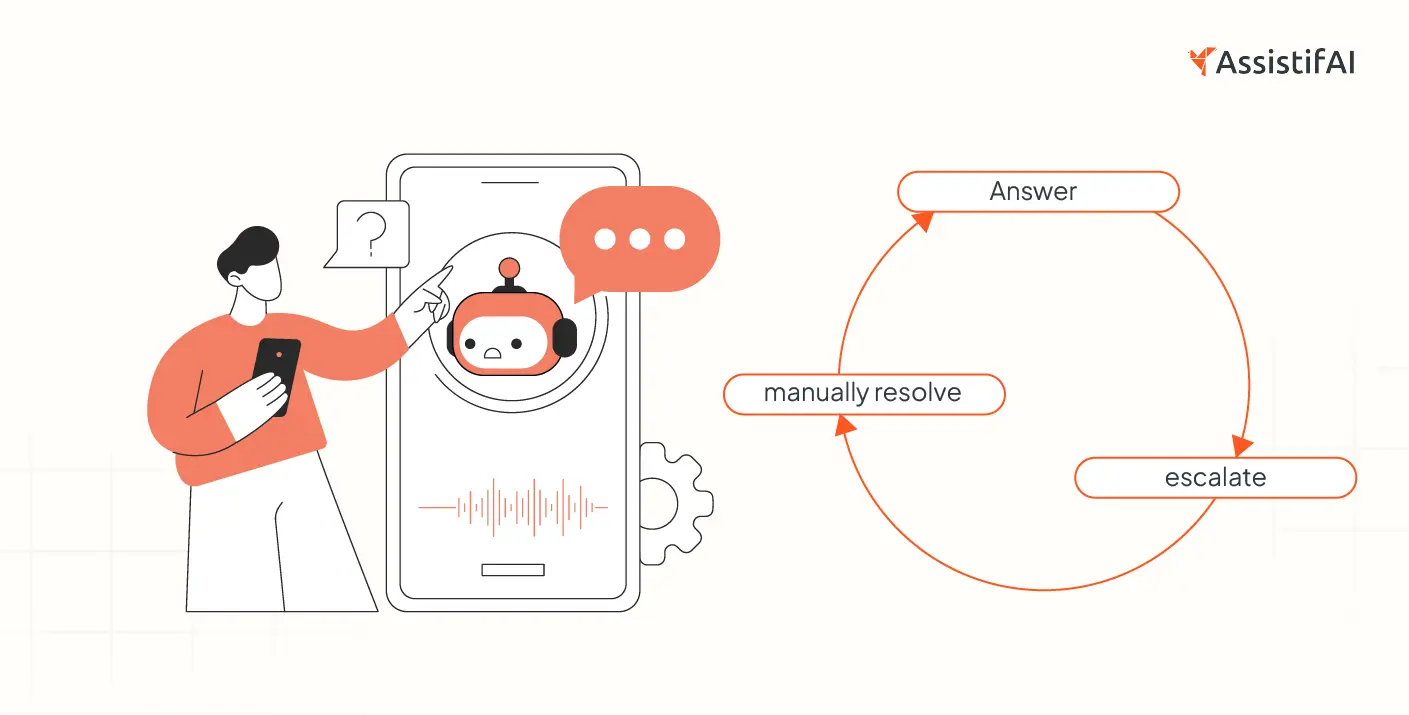
Generative AI voice assistants break this loop. They don’t just respond. They complete the task.
Why Current Voice Systems Are Failing Business Operations?
Because most systems respond but don’t resolve, that gap creates more work for teams.
According to a Salesforce report (2023), over 60% of customers expect faster responses, but many feel businesses fall short.
The issue is not speed. It is those conversations that don’t lead to completion.
Why Do Siri and Alexa Fail in Business Workflows?
They were built for personal use, not operations. That limitation shows up immediately in business scenarios.
They can set reminders or answer simple questions, but they cannot handle workflows or system-level actions. There is no deep integration with CRMs, order systems, or support tools.
This means they sound useful but fail when real work needs to happen.
What Are Traditional Chatbots Missing?
They depend on predefined rules. This makes them predictable but fragile.
Traditional chatbots follow decision trees and break when users deviate from expected inputs. They also require constant updates to stay relevant.
Most importantly, they cannot take action. They answer questions but cannot execute tasks.
The Shift from Answering Questions to Executing Work
A generative AI voice assistant is a system that understands spoken input, generates contextual responses, and completes tasks by connecting to business tools. It does not stop at conversation. It finishes the job.
It combines speech recognition, large language models, and workflow execution. Therefore, it is also called a conversational AI voice assistant or an AI-powered voice assistant.
They moved from answering to executing. That is the core shift.
A voice AI assistant powered by generative AI can understand intent, maintain context, and trigger actions. It connects directly with business systems to complete tasks.
This is not an improvement. It is a different model.
Siri vs Chatbots vs Generative AI Voice Assistants

The difference is simple. Only one category actually completes tasks.
What Does “Action-Taking” Mean?
It means the assistant completes the task instead of stopping at a response.
A conversational AI voice assistant can process orders, trigger workflows, and execute internal tasks. It updates systems in real time without human involvement.
Instead of redirecting users, it resolves the issue within the same interaction.
Real Example: E-commerce Order Queries
Most e-commerce support queries are repetitive and time-consuming. These include order tracking, delivery updates, and changes.
According to Shopify, automation and AI-driven support are becoming critical as merchants scale customer interactions.
A generative AI voice assistant can fetch order details, update delivery preferences, trigger notifications, and log actions instantly. This removes the need for manual follow-ups.
What does this mean for Cost, Speed, and Team Efficiency?
Manual processes do not scale. Teams spend time switching between tools instead of solving problems.
Most setups involve multiple systems for chat, CRM, and workflows. This creates delays and inconsistencies.
A voice AI assistant unifies these into a single system that handles both conversations and execution. In this way, it can eliminate the need for personnel dedicated to basic customer service interactions or internal task management. The result is that we can save labor costs while reallocating resources to more strategic roles that require human insight.
Where Businesses Go Wrong?
They try to improve outdated chatbot systems rather than replace them. This leads to more complexity without better results.
Adding more rules does not fix the core limitation. The system still cannot act.
The problem is not the interface. It is the underlying architecture.
How to Choose the Right AI Voice Assistant?
Focus on voice assistants that execute, not just conversation. That is where the real value lies.
Look for systems that understand natural language, connect with business tools, and execute workflows. It should not require heavy technical effort to set up.
If it only answers questions, it is not enough.
What Should You Take Away?
Siri and Alexa made voice accessible, but not useful for business workflows. Chatbots improved response time but still rely on manual intervention.
Generative AI voice assistants change this by completing tasks. They reduce workload rather than add to it.
This is why businesses are moving in this direction.
Where Does AssistifAI Fit in This Shift?
Most “AI tools” are still stitched-together systems that pretend to be unified: one tool for chat, another for workflows, another for execution. Teams spend more time managing tools than solving problems.
AssistifAI takes a different approach. It treats conversations, workflows, and execution as a single system rather than separate layers. The assistant does not just reply. It completes the task across systems without forcing handoffs.
It is also built for people who are not engineers. Instead of long setup cycles and constant tweaking, teams can upload their data, define what needs to happen, and deploy working assistants quickly. The goal is simple: fewer tools, fewer steps, less manual work.
Explore What This Looks Like in Practice
Most businesses still rely on multiple tools that do not work together. This creates delays and manual effort.
Platforms like AssistifAI bring conversations, workflows, and execution into one system. This allows teams to deploy AI assistants without technical complexity.
FAQs
What is a generative AI voice assistant?
A generative AI voice assistant understands spoken input, generates responses, and executes tasks by connecting to business systems.
How is a conversational AI voice assistant different from a chatbot?
A conversational AI voice assistant understands context and takes action, whereas chatbots follow predefined rules and mostly respond rather than execute tasks.
In what ways can generative AI provide more personalized experiences for users?
Generative AI enables the creation of highly personalized content, allowing users to engage with tailored experiences. Also, user interfaces can be generated to match individual preferences and needs, moving beyond generic designs.
Why are Siri and Alexa not suitable for business use?
They are designed for personal use and lack integration with business systems and workflow execution capabilities.
What are the benefits of AI-powered voice assistants?
They reduce manual work, improve response time, and automate workflows across systems.
Are generative AI voice assistants easy to set up?
Many modern platforms offer no-code or low-code setups, making them accessible for non-technical users.

Read More Blogs

Your next hire isn't human.


AssistifAI automates your workflows and delivers exceptional voice and chat-based customer support helping your business grow faster, save time, impress clients, and stay ahead of the competition.