

Customer Service Chatbot AI for Retail: How to Handle 5x More Queries During Peak Season Without Extra Headcount
TL;DR
Problem: The holiday season breaks retail customer service every year. Volume spikes, response times collapse, and agents spend 70% of their time answering the same five questions: order status, delivery delays, returns, sizing, and stock availability.
Shift: A Customer service chatbot AI deflects up to 79% of standard queries automatically.
Fix: The right ecommerce AI chatbot automation setup handles routine queries end-to-end, escalates with full context, and updates your CRM in real time. The gap most retailers miss is not the tool. It is the timing and configuration before peak season hits.
Why Does Peak Season Break Retail Customer Service Every Single Year?
Most retail support teams know peak season is coming. They still get buried. Contact volume rises 42% in holidays, according to Zendesk State of Support 2025, and that spike hits every channel at once through web chat, email, social DMs, and phone.
The queries driving that volume are almost entirely predictable:
- "Where is my order?" accounts for the single largest share of holiday support tickets
- Return and exchange requests surge in the week after peak seasons
- Delivery delay notifications trigger waves of identical follow-up queries
- Stock availability questions peak during gifting windows
Here is what makes this worse.
Only 7% of companies today offer seamless cross-channel transitions, and 62% of customer service channel transitions are high-effort for customers, according to Gartner. So customers who cannot get a fast answer on chat move to email, then to phone. One unresolved query creates three tickets across three channels.
Hiring seasonal staff does not fix this. By the time a temporary agent is onboarded and trained on your return policy, your return window is already open.
How Does a Customer Service Chatbot AI Actually Handle 5x Query Volume?
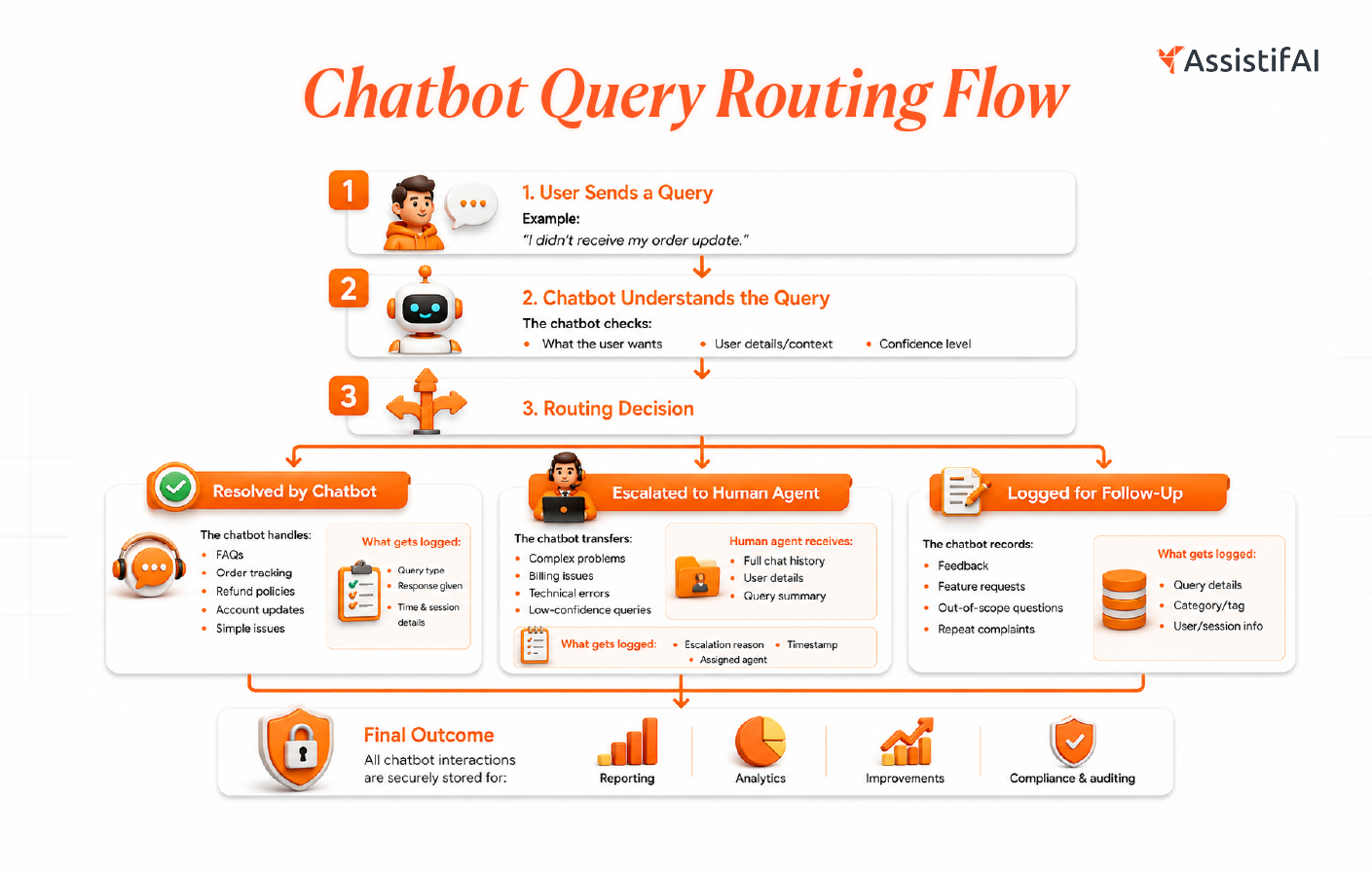
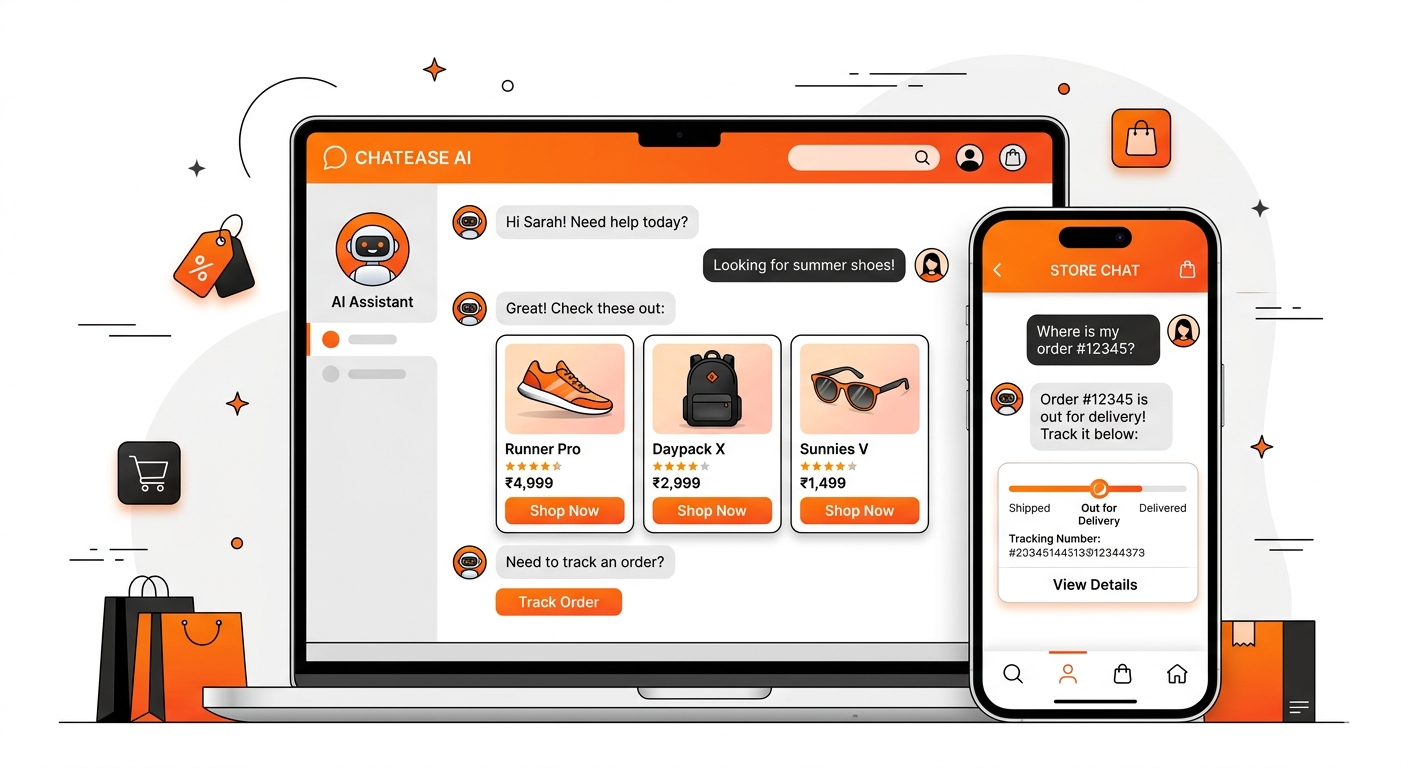
A customer service chatbot AI handles volume spikes by running hundreds of simultaneous conversations with zero queue time.
The deflection rate, which means the percentage of queries resolved without a human agent, determines how much pressure it takes off your team.
Chatbots can answer up to 79% of standard questions, reducing the need for human involvement, and can save businesses up to 30% on customer support costs while providing immediate responses to 90% of inquiries.
For retail, here is how that breaks down by query type:
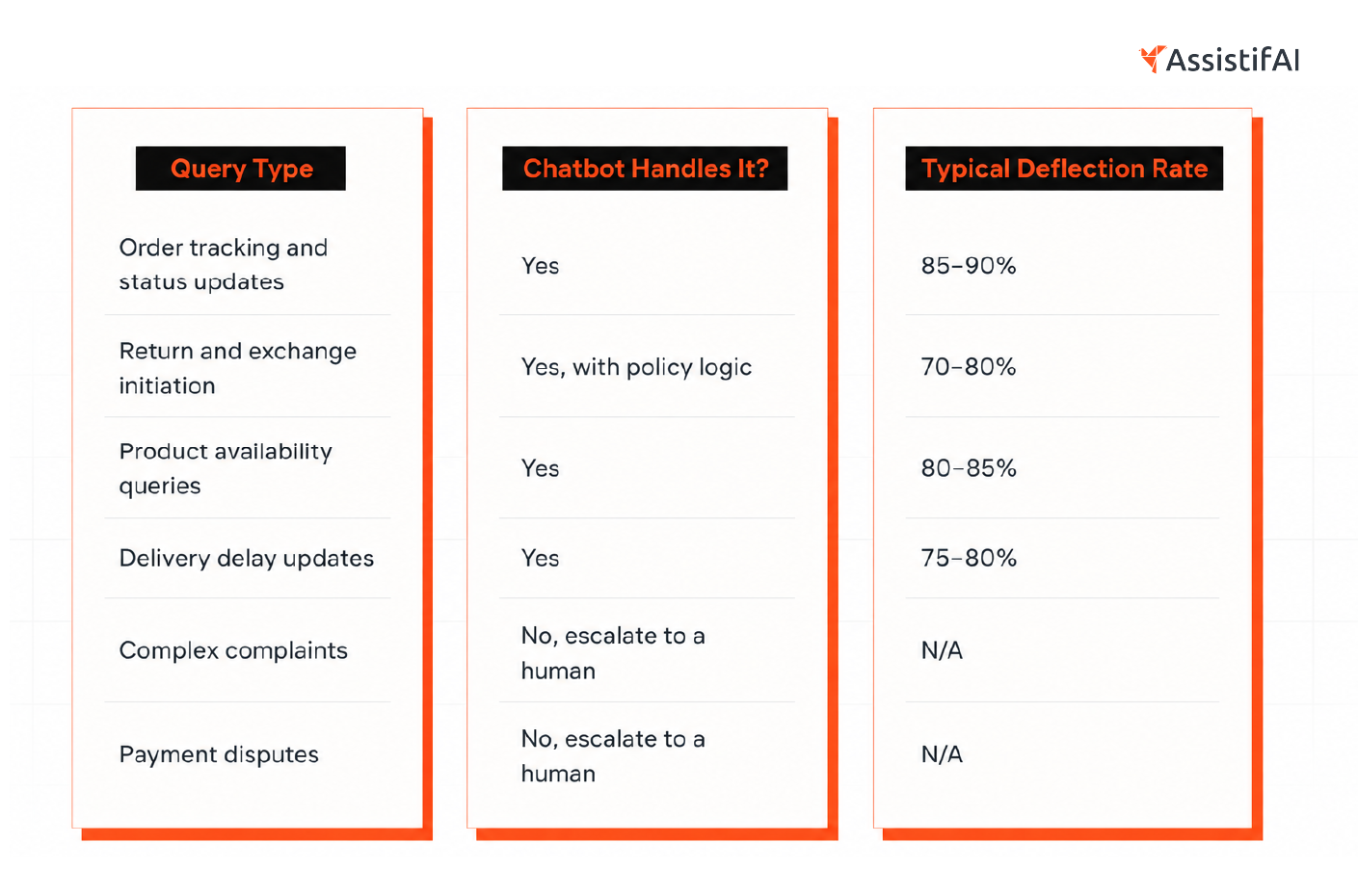
The math matters for SMB retailers. If your team handles 500 queries per day in December and a chatbot deflects 75% of them, your agents handle 125.
Same team. A quarter of the pressure. Full context on every escalation that comes through.
What makes this work is not deflection alone. It is what happens to the queries that the chatbot cannot resolve. A chatbot that dead-ends customers is worse than no chatbot.
What Results Are Retailers Actually Getting?
The strongest proof point is not a global brand with a hundred-person tech team. It is a mid-size retailer with a lean support operation.
Anker, a global consumer electronics brand, operates with just 300 support agents handling over 2 million tickets annually across Asia, North America, Europe, and the Middle East.
Each agent regularly worked 10-hour shifts during peak periods. After deploying AI chatbot automation, Anker absorbed that ticket load without additional headcount and brought agent hours back to sustainable levels.
H&M reported a 25% higher conversion rate among chatbot users than from traditional browsing and a 20% decrease in cart abandonment, with approximately 60% of visitors engaging with the chatbot.
Sephora's chatbot on Facebook Messenger also delivered notable results, achieving a 30% increase in customer engagement and handling product queries, appointment bookings, and personalized recommendations during peak periods without scaling its support team.
The pattern across all three is that the chatbot was not deployed as a cost-cutting measure. It was deployed to handle the volume that the human team structurally could not handle. That replacement is important for any retailer evaluating whether the setup time is worth it.
What Should You Look for in a Retail Chatbot for Customer Service?
The right retail chatbot is not the one with the most integrations on its pricing page. It is the one your operations team can update in 10 minutes when your Christmas return policy changes.
Key criteria to check:
How Do You Implement a Retail Chatbot Before the Holiday Rush?
- Audit last year's top 10 holiday query types. Order tracking, returns, delivery delays, and stock questions. These are your chatbot's first job. Configure these before anything else.
- Set your peak-season policy language separately from your standard configuration. Your Christmas return window, your December delivery promises, and your gift wrapping queries need their own responses, loaded before November.
- Define your escalation triggers precisely. Complaints with emotional tone. Payment disputes. Order errors requiring investigation. The tighter your escalation rules, the fewer false escalations your team handles.
- Test during low-volume conditions. Deploy in October. Run live customer conversations. Find the gaps. Fix them before peak volume hits.
- Brief your support team on what changes. They need to know which query types the chatbot now owns, what escalations will look like, and how to pick up a conversation mid-thread without asking the customer to repeat themselves.
The teams that fail skip steps 2 and 4. They deploy a chatbot with standard policy language and no peak-season configuration, then wonder why customers are getting wrong answers about returns in late December.
How sad!
What Mistakes Do Retailers Make When Deploying AI Chatbots for Peak Season?
Most chatbot deployment failures are not technology failures. They are process failures that happen before the first conversation starts.
Given below are the top mistakes:
Configuring once and never updating. Your return policy, delivery SLAs, and stock messaging change during peak season. A chatbot that was accurate on November 1st may be confidently wrong by December 15th. Build a policy update cadence into your peak-season prep, rather than reacting to customer complaints.
Launching without a defined escalation path. A chatbot with no clear route to a human agent creates a loop that customers cannot escape. Less than half of customers who experience a high-effort service transition will use self-service again for their next interaction. A bad chatbot experience does not just lose the current query. It damages trust in every future self-service interaction.
Treating deflection rate as the only success metric. A chatbot that deflects 80% of queries but handles the remaining 20% incorrectly creates more work than it saves. Track resolution rate, not just deflection rate. The difference is whether the customer's problem was actually solved.
Deploying on one channel only. Customers contact retailers through every available channel when they are frustrated about a late delivery. A web-only chatbot leaves every WhatsApp, Instagram DM, and mobile query unautomated.
Ignoring the post-Christmas return surge. Most retailers focus chatbot configuration on the pre-Christmas gifting period. The week after December 25th is when return query volume peaks. Configure for that window specifically. It is the most predictable surge point in the entire retail calendar.
Conclusion: The Problem Is Not the Volume. It Is the Preparation.
Every Christmas and other peak seasons, retail customer service breaks down for the same reason. The volume is predictable. The queries are predictable. What changes is whether the system behind your support operation is ready to absorb it.
The average chatbot ROI is approximately 1,275%, based on support cost savings alone. That number only materializes when the chatbot is configured to actually do the work, not just answer FAQs on a static page.
Retailers that handle 5x the query volume without additional headcount are not using more sophisticated technology. They are using better-prepared technology. Chatbot configuration updated before peak season opens. Escalation logic is defined before the first frustrated customer hits a dead end. Policy language loaded for Christmas, not for August.
AssistifAI handles customer queries across voice, web, and WhatsApp from a single setup. It connects to your existing tools natively, updates in plain language without developer support, and deploys in under 2 minutes. Configure it in October. Adapt it anytime your policies change.
Walk into December ready.
Set up your AI customer service assistant
FAQs
What is a customer service chatbot AI, and how does it work in retail?
A customer service chatbot AI is software that handles customer queries through automated conversation using natural language processing. In retail, it connects to your order management system and responds to tracking requests, return initiations, stock queries, and delivery updates without human intervention. It escalates to a human only when the query requires judgment, investigation, or emotional handling.
How many customer queries can a retail chatbot handle during the Christmas peak season?
A properly configured retail chatbot for customer service handles between 65% and 79% of routine queries without human intervention, according to data from Zendesk and Sobot in 2025.
Does deploying a retail chatbot mean replacing customer service and staff?
No. The most effective deployments use chatbots to handle high-volume, repetitive queries so human agents can focus on other tasks, such as complaints, disputes, and issues that require genuine judgment.
What is the biggest mistake retailers make when deploying a chatbot for peak season?
Configuring the chatbot once and never updating it. Your Christmas return window, December delivery SLAs, and peak-season stock messaging are all different from your standard operating conditions.
How early should a retailer deploy a chatbot before the holiday season?
Before 2 months is the right target. You need at minimum four to six weeks of live operation before peak volume hits, so you can identify configuration gaps, update policy language, and train your team on the new escalation flow.

Read More Blogs

Your next hire isn't human.


AssistifAI automates your workflows and delivers exceptional voice and chat-based customer support helping your business grow faster, save time, impress clients, and stay ahead of the competition.