
How Businesses Are Using AI Call Center Agents to Replace Traditional Reps and Cut Operational Costs by 60%

TL;DR
Human agents cost $7 to $12 per call and still miss follow-ups. AI call center agents handle the same interactions for under $1, book appointments in real time, and automatically execute post-call workflows. Smart businesses are closing the conversion gap left by fragmented tools with conversational AI call center agents.
Most businesses do not have a customer support problem. They have a fragmentation problem. One tool for calls, another for follow-ups, a third for CRM updates, and a person manually connecting all three. That is where leads disappear and costs compound.
This blog covers what an AI call center agent is, how it works step by step, how much it costs compared to a human rep, which industries use it, and what to evaluate before committing to a platform.
What Does an AI Call Center Agent Actually Cost Compared to a Human Rep?
An AI call center agent is the real workflow executor for your business. Instead of just blindly answering every call, a proper AI call center agent updates your CRM, sends a follow-up message, and routes the lead forward after the conversation ends. The per-call math is the clearest entry point for any business evaluating AI contact center automation.
A human agent who handles a single inbound call costs between $7 and $12 on average, according to industry benchmarks from Callbotics and Gartner. An AI agent handles the same call for under $1.
See the difference.
At scale, the gap becomes a structural cost advantage.
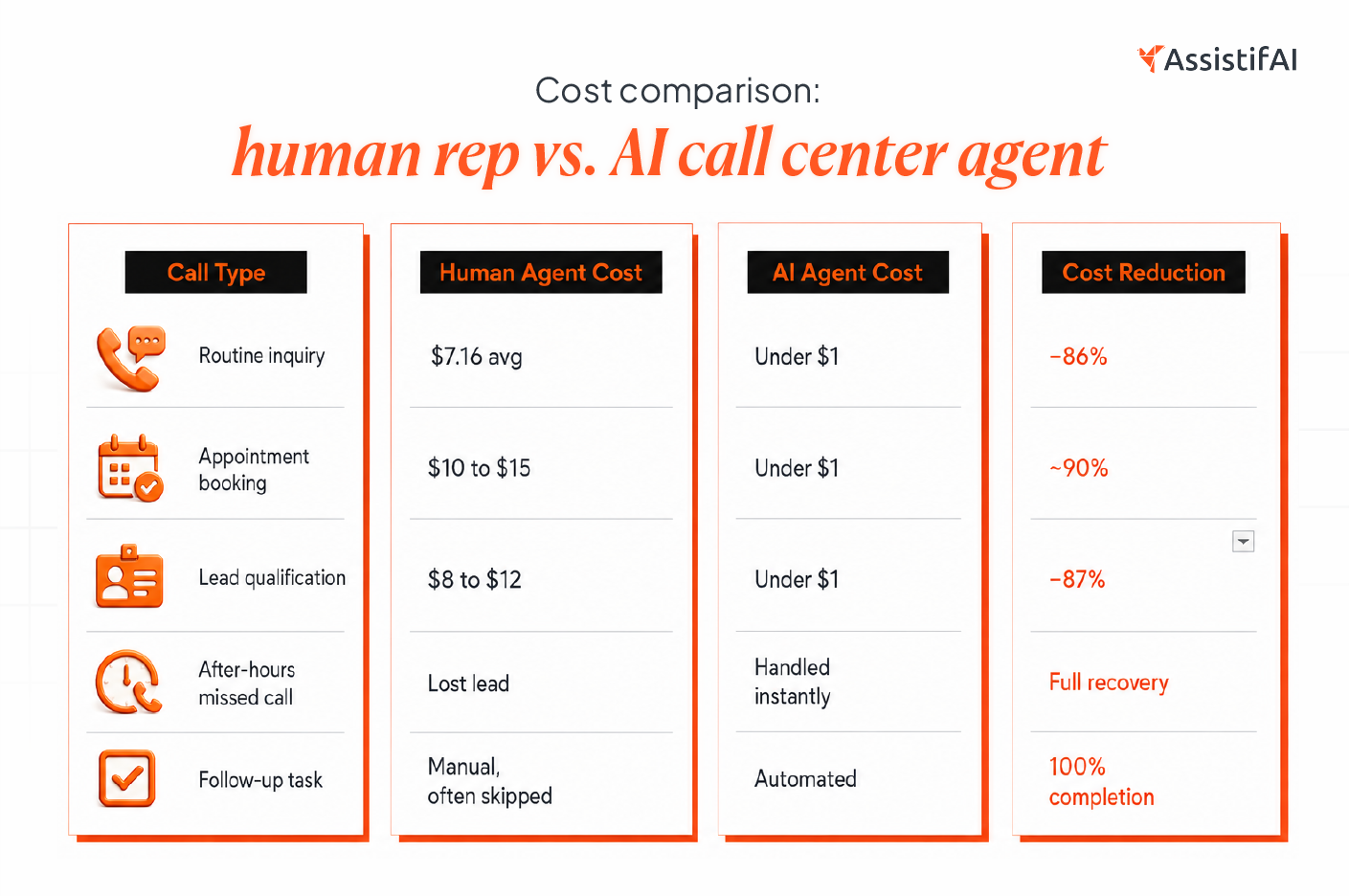
Sources: Callbotics 2025, Gartner, Freshworks CX Benchmark 2025
Freshworks' 2025 CX benchmark data shows AI agents deflect over 45% of incoming customer queries, with retail and travel exceeding 50%. At $10 per call and 10,000 monthly contacts, that is a $45,000 monthly cost reduction before any other changes are made.
How Does an AI Call Center Agent Actually Work?
Here is the typical process for a standard inbound call.
A customer calls, waits on hold, explains their issue, and the agent reads from a script or looks up a record. If follow-up is needed, it goes onto a task list that, a large share of the time, never gets actioned.
A virtual call center AI agent rewires every step of that sequence in real time.
The step-by-step workflow:
- Instant pickup- The call is answered immediately with no hold queue.
- Data-aware response- The AI accesses your products, schedules, and client history to give precise answers.
- In-call execution- Appointments are booked, leads qualified, and forms submitted during the conversation.
- Automated follow-up- Missed calls trigger callbacks, and new leads get follow-up messages without human input.
- Escalation with context- Complex calls go to a human agent with the full conversation history already attached.
- Visibility layer- Every interaction is logged, reportable, and trackable across the full customer journey.
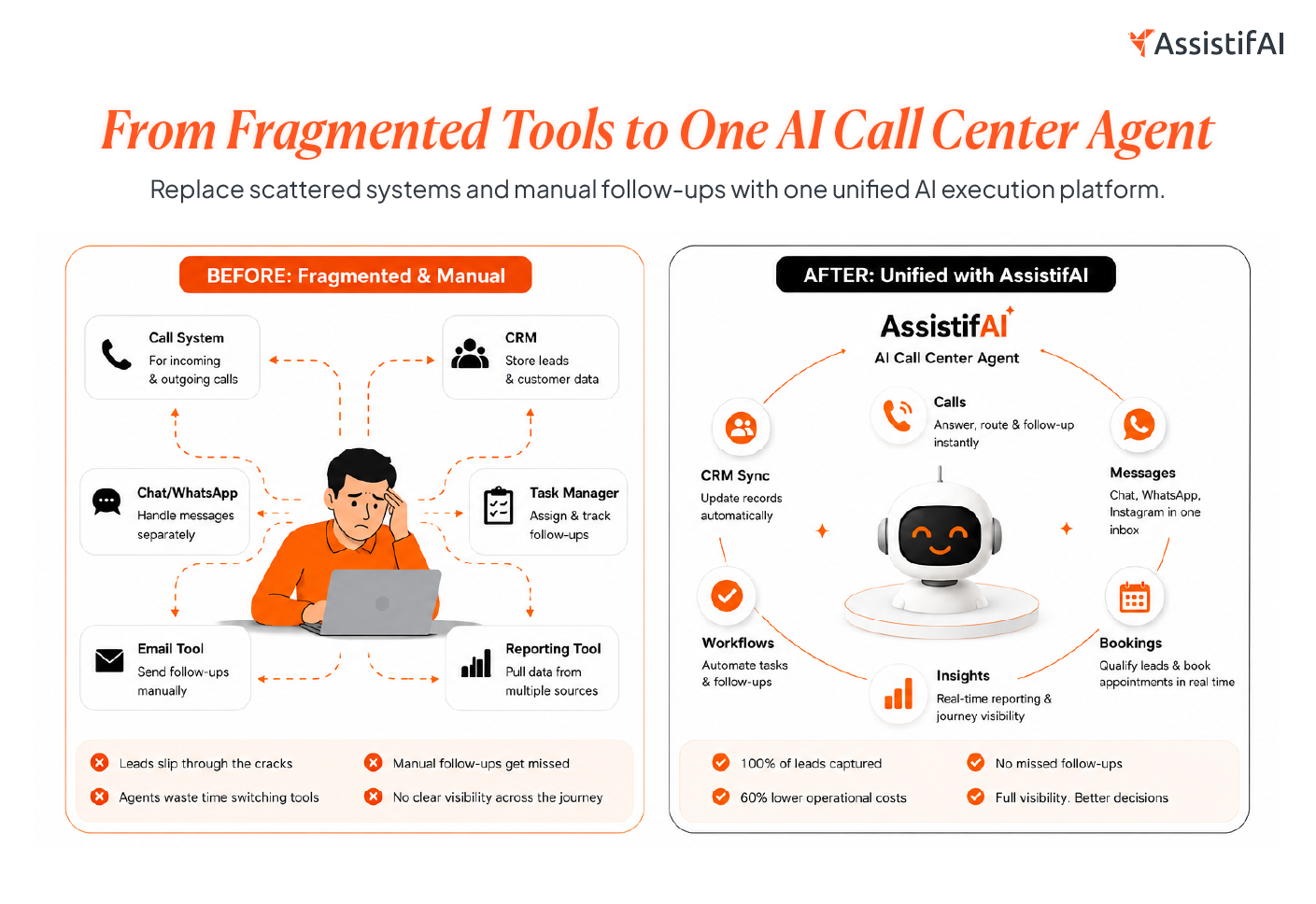
The gap most platforms leave open is steps four and five. They handle the conversation. They leave execution to you.
Why Are Businesses Switching to AI Call Center Agents Now?
Because the cost of waiting has become visible.
Labor accounts for up to 95% of contact center costs, according to Gartner. Contact centers face 30 to 45% annual agent turnover, and each departure costs between $22,500 and $42,000 to replace, per Insignia Resources (2025). That cycle of hiring, training, and losing staff makes scaling a manual support operation structurally expensive.
The business case for switching breaks down into four pressure points:
- Labor cost: Human agents cost 10x more per call than AI agents
- Availability gap: Human agents cannot cover nights, weekends, or sudden volume spikes
- Execution gap: Manual follow-up fails on a consistent basis at every stage of the pipeline
- Fragmentation cost: Most companies run separate tools for calls, CRM, follow-ups, and analytics, and connect them manually
AI-driven contact centers can cut operational costs by 65-90% while improving First Call Resolution (FCR) and Average Handle Time (AHT), according to Callbotics (2025). That is not a projection. That is what early adopters in finance, retail, and telecom are reporting now.
Which Industries Are Using AI Call Center Agents and How?
AI contact center automation is not a single use case. It plays out differently depending on the operational structure of each industry.
Summary by Industry:
What Should Business Leaders Evaluate Before Choosing an AI Call Center Agent?
This is where most decisions go wrong. Leaders compare features when they should compare systems.
A voice bot is not the same as an AI call center agent. A voice bot answers calls. An AI call center agent answers calls, executes workflows, closes the follow-up loop, and gives you visibility across every stage of the customer journey. If a platform cannot do all four, it is a temporary solution. Don’t purchase it.
Six questions to ask before committing to any platform:
- Does the AI execute post-call workflows, or does it hand that back to your team?
- Is follow-up automated across channels, including WhatsApp and voice?
- Can it be customized for your specific workflows without an engineering team?
- Does it provide visibility into where leads drop, what converts, and what fails?
- What does deployment actually look like, and does the vendor stay involved after launch?
- How does the system handle calls it cannot resolve?
The answers to these questions separate a tool from an operational system.
How Does AssistifAI Approach AI Call Center Automation Differently?
Most AI call center platforms give you one layer. You still need separate tools for CRM updates, follow-up sequences, analytics, and workflow management, and your team manually connects them all. That is where performance breaks down.
AssistifAI replaces that fragmented stack with a single AI execution platform. Conversations, follow-up, conversion, and visibility run from a single system, with no tools to integrate manually.
Platform comparison:
What AssistifAI specifically delivers:
- Website scan generates a functional assistant in roughly 60 seconds
- Custom agents built for specific workflows: insurance quotes, inventory checks, appointment types, and intake forms
- Omnichannel deployment across web chatbot, voice, WhatsApp, Instagram, and public URL
- Automated follow-up that triggers without any manual input
- Full journey visibility so you see exactly where leads convert or drop off
Most platforms leave you after onboarding. AssistifAI works with clients to refine workflows, monitor performance, and optimize outcomes over time. That is the difference between a tool purchase and an operational upgrade.
What Are the Most Common Mistakes When Deploying AI Call Center Agents?
- Not mapping workflows before automating. If you do not know your top 15 call drivers from last month's data, you cannot build flows for them. Start with data, not assumptions.
- Treating AI as a cost-cut rather than an ops rebuild. The businesses achieving 60% cost reductions are not just removing headcount. They are rebuilding how calls, follow-ups, and conversions work from end to end.
- Picking a voice tool and calling it a system. A bot that does not connect to your CRM, does not trigger follow-up, and does not provide visibility is a modern IVR. Execution matters more than conversation quality.
- Going DIY after onboarding. Workflows that drive real ROI take weeks of refinement, not an afternoon of setup. Platforms that disappear after launch typically do not deliver measurable results.
- Overlooking the post-call layer. Most missed conversions happen after the conversation ends. Follow-up completion is where the money is, and it is where most deployments fail silently.
The Bottom Line
Every call that goes unanswered, every follow-up that never happens, every lead that falls through the gap between your voice tool and your CRM is a fragmentation problem. Not a technology problem.
AI call center agents close those gaps. Faster response, automated execution, real-time conversion, and full visibility from first contact to close.
The math compounds quickly. A 45% deflection rate on 10,000 monthly calls saves $45,000 per month. A 60% reduction in operational costs is achieved every quarter without a hiring cycle.
If you want to see how this works against your actual workflows,
FAQs
What is an AI call center agent, and how does it differ from a chatbot?
An AI call center agent handles voice and multi-channel customer interactions and executes workflows in real time after each conversation. A chatbot delivers scripted, text-based responses and stops there. The AI call center agent books appointments, updates your CRM, triggers follow-up messages, and routes leads, all without manual input.
How much can a business realistically save by switching to an AI call center agent?
Per-call costs fall from an average of $7 to $12 for human agents to under $1 for AI-handled interactions. AI-driven contact centers report 65-90% reductions in operational costs, depending on call volume and workflow complexity, according to Callbotics (2025). At 10,000 monthly contacts, a 45% AI deflection rate saves roughly $45,000 per month based on Freshworks' 2025 CX benchmark data.
Does an AI call center agent work for small businesses, or only for enterprises?
It works for both. Small businesses get 24/7 coverage, instant response, and automated follow-up without adding headcount. Enterprise deployments focus on scale, workflow complexity, and cross-department integration. The economics are strong at both ends.
What happens to calls that the AI cannot handle?
Complex or sensitive calls are escalated to a human agent. The AI passes the full context, including call history, customer data, and what was discussed, so the agent does not have to start from scratch. This reduces average handle time and improves first-call resolution rates.
How long does it take to deploy a virtual call center AI agent?
Basic deployment can happen in minutes. Platforms like AssistifAI generate a functional assistant from a website scan in roughly 60 seconds. Custom agents for specific workflows take longer because they require mapping real business processes. Most serious deployments are operational within days, not months.
Is AI contact center automation reliable enough for real customer conversations?
Reliability depends on how the system is built and maintained. AI agents trained on your actual business data with clear escalation logic handle real conversations consistently. Gartner projects that 73% of customer service organizations will implement agent assist solutions by the end of 2025. The question is no longer whether AI is reliable. It is whether your current setup is reliable enough to justify the delay.

Read More Blogs

Your next hire isn't human.


AssistifAI automates your workflows and delivers exceptional voice and chat-based customer support helping your business grow faster, save time, impress clients, and stay ahead of the competition.