

AI Call Agent: How to Design Inbound Call Flows, Handle Multi-Intent Queries, and Escalate to Human Agents Seamlessly
Every unnecessary call transfer increases handling costs, delays resolution, and creates customer frustration. For businesses managing hundreds or thousands of inbound calls every month, even a small routing mistake can add hours of agent workload and increase repeat contacts.
Many companies deploy an AI call agent expecting it to solve these problems automatically. The reality is different. Most AI call flows perform well when handling simple requests but struggle when callers have multiple needs, emotions escalate, or human intervention becomes necessary.
The difference between a successful AI deployment and a failed one usually comes down to call flow design. Businesses that design for complexity from the beginning see higher first-call resolution rates, fewer transfers, and shorter handle times.
This blog explains how to build inbound AI call flows that accurately identify intent, manage multi-intent conversations, and escalate to human agents without requiring customers to repeat themselves.
TL;DR:
AI call flows fail not because the technology is weak, but because the design stops at simple queries. Businesses need flows that accurately detect caller intent, manage multiple requests in a single call, and route to the right human agent while preserving full context. The difference between a resolved call and a dropped one is usually a routing decision made three seconds too late.
What Is the Real Cost of Poor Call Routing?
Traditional IVR and scripted call systems were built for volume, not complexity. They route calls, not conversations.
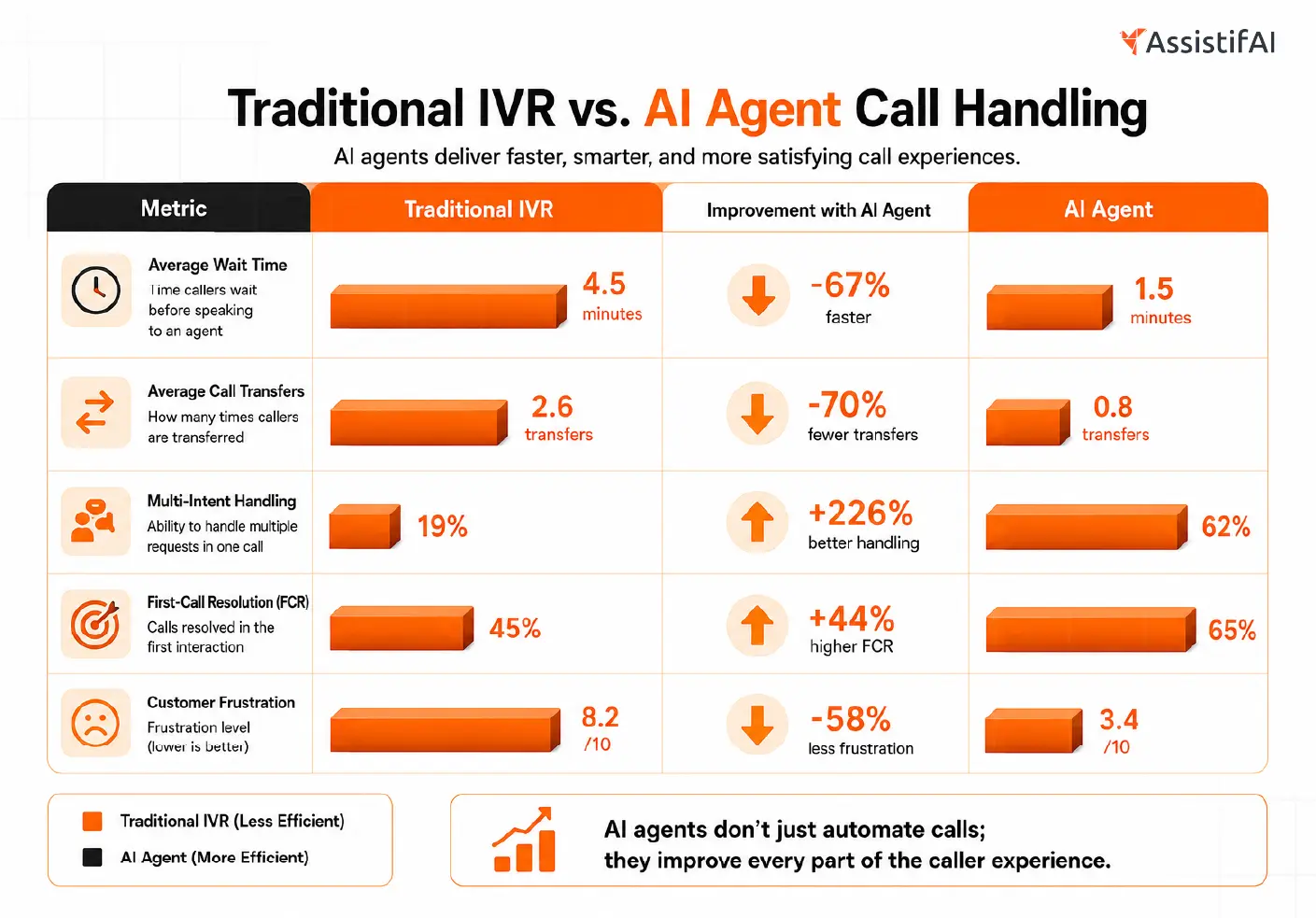
The most common failure is the transfer loop. A caller gets routed to department A, explains the issue, gets transferred to department B, and has to explain it again. According to Salesforce research, 72% of customers expect agents to know their history before they speak. Traditional systems offer none of that.
Wait times compound the problem. When hold queues are long, frustrated callers reach human agents already primed for a bad interaction. That frustration does not start with the agent. It starts in the IVR.
Given below are the actual costs of poor call routing:
- Longer average handle times
- Higher staffing costs
- Lower first-call resolution
- Increased customer churn
- More repeat calls
The structural issues that cause this:
- Calls are transferred based on department, not caller intent
- CRM and ticketing data are not pulled into the call in real time
- Multi-intent calls (a caller asking about billing and a delivery delay in one call) force a second transfer
- There is no feedback loop. Failed calls do not improve the system
These are not technology problems. They are design problems. Fixing them requires rethinking what a call flow is supposed to do.
The Four Building Blocks of a High-Performing AI Call Flow
A well-designed inbound AI call flow does four things: it greets and qualifies the caller, identifies what they need, determines whether AI can resolve it or must escalate, and manages the call if the caller has multiple requests.
Step 1: Identify and Verify the Caller
This is the first data-collection step.
A strong AI greeting captures the caller's name, account number, or phone number within the first 30 seconds. This pulls relevant data from the CRM before the caller finishes stating the issue. The caller does not need to repeat their account number to three different agents because the system already has it.
Verification should feel natural, not interrogative. "Can I confirm the number you're calling from?" is less friction than "Please enter your 10-digit account number followed by the pound key."
Step 2: Detect Every Intent in the Conversation
Intent detection is the engine of the entire flow. Get this wrong, and every downstream decision is wrong too.
Modern AI call agents use natural language understanding (NLU) to classify intent from conversational input. A caller who says, "I got charged twice last month, and I still haven't received my order," has two distinct intents: a billing dispute and a delivery query. The system needs to log both, not just the first one it detects.
Intent confidence scores matter here. If the AI's confidence in classifying intent falls below a defined threshold, that should trigger a clarification prompt rather than a guess. A wrong assumption wastes the caller's time and trains them to distrust the system.
Step 3: Resolve or Route Based on Complexity
Routing logic is a decision tree, but it should not feel like one to the caller.
The system evaluates three things: intent complexity, sentiment signals, and resolution history. If a query is within scope (FAQ, booking, status check), AI handles it. If the query requires account-level judgment, a policy exception, or involves a complaint, the system escalates.
The rule of thumb: If resolving the issue requires discretion, escalate. If it requires information retrieval, the AI can handle it.
Step 4: Escalate with Full Context
Multi-intent calls are common, and most systems handle them poorly by closing the call after the first resolution.
The fix is a queue-based approach. The AI logs all detected intents at the start of the call and works through them sequentially. After resolving one issue, it confirms whether the caller has additional needs before closing. This single change reduces callback volume.
If intents span departments (billing and logistics, for example), the AI completes what it can and hands off a structured summary to the next agent rather than a cold transfer.
The Most Common AI Call Flow Mistakes Businesses Make
- Escalating Too Late
Customers become frustrated before reaching a human.
- Escalating Too Early
The AI never delivers meaningful efficiency gains.
- Treating Multi-Intent Calls as Single Requests
The first problem has been solved. The second creates a callback.
- Routing Based on Departments Instead of Intent
Transfers increase even when the answer exists elsewhere.
When and How Should a Call Escalate to a Human Agent?
Escalation is not a fallback. It is a designed outcome for a defined set of situations. Treating it as a failure creates systems that escalate too late.
Three signals should always trigger escalation:
- Failed intent detection: The AI cannot confidently classify the caller's request after two clarification attempts
- Negative sentiment escalation: Tone analysis detects frustration, anger, or urgency above a defined threshold
- Explicit request: The caller asks to speak to a person
Businesses often set escalation thresholds too high. They want AI to resolve as much as possible, which is reasonable, but holding a frustrated caller in an AI loop past the point of recovery is worse than transferring them immediately. A good rule: if the caller has said "that's not what I mean" or equivalent twice, escalate.
How Do You Hand Off a Call Without Making the Caller Repeat Themselves?
The handoff is where most escalation flows break. The caller is transferred; the human agent answers, "How can I help you today?" That question signals to the caller that nothing was retained.
A clean handoff passes a structured context summary to the agent before the call connects. This includes:
- Caller identity and account data
- Intents logged during the AI interaction
- Steps already attempted
- Sentiment score at the point of escalation
The agent receives this in their interface before speaking a word. The first thing they say should demonstrate they already know the context: "I can see you're calling about the billing charge from last month. Let me pull that up."
How Does Skill-Based Routing Get the Right Human on the Call?
Not every human agent can handle every query type. Routing a complex billing dispute to a tier-1 agent who cannot process refunds wastes everyone's time.
Skill-based routing matches the intent of the escalated call to the agent profile best suited to resolve it. An agent tagged as "billing specialist" with availability gets the billing dispute. An agent tagged "logistics" gets the delivery query. The system does not route to the nearest available agent. It routes to the most capable available agent.
This reduces internal re-transfers, which are the single biggest driver of handle time and customer dissatisfaction.
How Should AI Call Flows Connect With Your Existing Systems?
An AI call agent running in isolation is a voice interface. An AI call agent connected to your CRM, ticketing system, and analytics platform is an operational layer.
The integration priorities, in order of impact:
- CRM sync: Pull caller history and account data before the conversation starts. Push call outcomes and intent logs back after it ends.
- Ticketing integration: If an issue cannot be resolved on the call, automatically create a ticket with the full call context attached. No manual logging.
- Analytics platform: Route call data to your reporting stack so call volume, resolution rate, and escalation frequency are visible without manual export.
The practical benefit is faster resolution. Agents who can see the caller's last three interactions, open tickets, and account status in a single view resolve calls faster than agents who work from memory or switch between tabs. According to McKinsey, integrated agent desktops reduce average handle time by up to 20%.
Explore how AssistifAI's integrations connect call flows to your existing stack without custom development.
How Do You Measure Whether Your AI Call Flow Is Actually Working?
Measuring call flow performance is not optional. A flow that looks functional can still produce poor outcomes at scale.
The metrics that matter:
- First-call resolution (FCR): The percentage of calls resolved without a callback or transfer. This is the primary indicator of flow quality.
- Average handle time (AHT): Time from call start to resolution. High AHT often signals routing inefficiency or poor intent detection.
- Escalation rate: How often calls transfer to a human. A very low rate may mean AI is handling calls it should not. A very high rate means the AI is not doing enough.
- Customer satisfaction (CSAT): Post-call survey scores correlated with flow type. Which intents produce the worst scores?
- Containment rate: The percentage of calls fully resolved by AI without human involvement.
Review these metrics weekly, not monthly. Call flow issues compound quickly. A routing logic error affecting 5% of calls may seem minor until you calculate the volume over 30 days.
Use the insights to run controlled tests. Change one variable at a time, such as the escalation sentiment threshold, and measure the impact before rolling changes broadly.
Where AI Call Flows Are Headed Next
- Predictive Routing Based on Customer History
- Conversations that continue across voice, chat, and WhatsApp
- AI that learns from escalated calls
- Compliance is built directly into call flows
Explore how AssistifAI's multi-channel AI handles this across voice, chat, and messaging.
How Does AssistifAI Handle Complex Call Flows and Human Escalation?
Most AI call projects fail for three reasons: they cannot handle multiple intents, they escalate without context, and they route callers to the wrong teams.
AssistifAI was built to address all three.
The platform detects multiple requests within the same conversation, intelligently prioritizes them, and resolves what it can before escalating. When a human agent is needed, the full conversation history, detected intents, and attempted actions are transferred automatically.
Instead of acting as a standalone voice bot, AssistifAI connects directly with CRM, ticketing, scheduling, and reporting systems so every call becomes part of a larger operational workflow.
AssistifAI also integrates with your call-handling and voice-automation workflow, so the call flow is not a standalone tool. It runs as part of the same system handling follow-ups, scheduling, and reporting.
Conclusion: What Should You Do Next?
The success of an AI call agent is rarely determined by speech recognition or automation accuracy alone. It is determined by what happens when conversations become complicated.
Businesses that achieve the highest first-call resolution rates design for multi-intent conversations, define escalation rules early, and ensure every handoff carries context forward. Those that do not often replace one customer frustration with another.
Before expanding AI across all call types, start with a single use case, such as billing inquiries, appointment scheduling, or order status requests. Measure first-call resolution, escalation rates, and customer satisfaction. The results will quickly reveal whether your call flow is helping customers or simply moving them into another queue.
And see how it manages conversations, execution, and escalation on a single platform.
FAQs
What is an AI call flow?
An AI call flow is the structured sequence of steps an AI voice agent follows when handling an inbound call. It defines how the AI greets the caller, detects intent, processes the request, decides whether to resolve or escalate, and closes or transfers the call. A well-designed call flow covers both the happy path and exception handling for frustrated or unclear callers.
When should an AI call agent escalate to a human?
Escalation should happen when the AI cannot confidently classify the caller's intent after two clarification attempts, when sentiment analysis detects sustained frustration or anger, when the caller explicitly requests a human, or when the query requires account-level judgment or a policy exception. Holding callers in an AI loop past these thresholds increases dissatisfaction and repeat calls.
How do you prevent callers from repeating themselves during an escalation?
The solution is a structured context handoff. Before the human agent picks up the call, the system passes a summary that includes the caller's identity, intents detected, steps already attempted, and a sentiment score. The agent sees this in their interface before speaking. This removes the need for the caller to re-explain the issue and signals immediately that their time was not wasted.
What is skill-based routing in an AI call center?
Skill-based routing matches an escalated call's intent to the human agent profile best equipped to resolve it. Rather than routing to the nearest available agent, the system identifies agents tagged with the relevant skill set (billing, logistics, technical support) and routes to the most capable available option. This reduces internal re-transfers and handling time.
How does integrating a CRM improve AI call flow performance?
CRM integration allows the AI to pull caller history, account status, and open tickets before the conversation begins. This means the AI can personalize the interaction, skip questions the caller has already answered, and route based on account-level data rather than just stated intent. After the call, the CRM is automatically updated with call outcomes, eliminating the need for manual logging.
What metrics should you track to evaluate an AI call flow?
The five metrics that matter most are first-call resolution (FCR), average handle time (AHT), escalation rate, customer satisfaction score (CSAT), and containment rate. FCR tells you whether calls are being resolved correctly. Escalation rate tells you whether the AI is handling the right calls. CSAT correlated by intent type tells you where the flow is producing bad experiences.

Read More Blogs

Your next hire isn't human.


AssistifAI automates your workflows and delivers exceptional voice and chat-based customer support helping your business grow faster, save time, impress clients, and stay ahead of the competition.