
What is an AI Chatbot? How it Works and Why Every Business Needs One in 2026?

Just imagine the boring day of human agents who type responses to customers' queries every single day, wasting much of their precious time.
Humans can make mistakes. And do you know why most businesses lose customers?
No one replies on time.
When a visitor lands on your site, has a question, waits, and then leaves, it indicates a need for improvement. A lead wants to know the pricing, gets a delayed response, and moves to a competitor.
Support queues grow. Teams burn out.
Just one delay can cost a business a lead.
There is a way to remedy this delayed response. Hiring an AI chatbot can improve productivity and reduce agents' workload. Proper setup and integration are key to ensuring your chatbot works seamlessly and gives you confidence in its effectiveness.
The shift is already happening. Future AI chatbots will automate entire workflows and transactions, opening new opportunities for your business to innovate and grow.
What Do You Mean by an AI Chatbot?
An AI chatbot is a software application that can understand user questions and respond in natural language, whether in text or voice, without human intervention.
Fixed scripts are not ruling them. It interprets human emotions, pulls context, and generates answers in real time.
Older chatbots worked like rule-based systems.
AI chatbots work like conversation engines.
They can:
- Answer questions.
- Handle more complex conversations.
- Guide users through decisions.
- Resolve support queries.
- Trigger actions like bookings, purchases, or sign-ups.
Businesses can take advantage of this to achieve marketing goals, increase sales, and improve customer service, with fewer delays and missed opportunities.
How is an AI Chatbot different from a Traditional Chatbot?
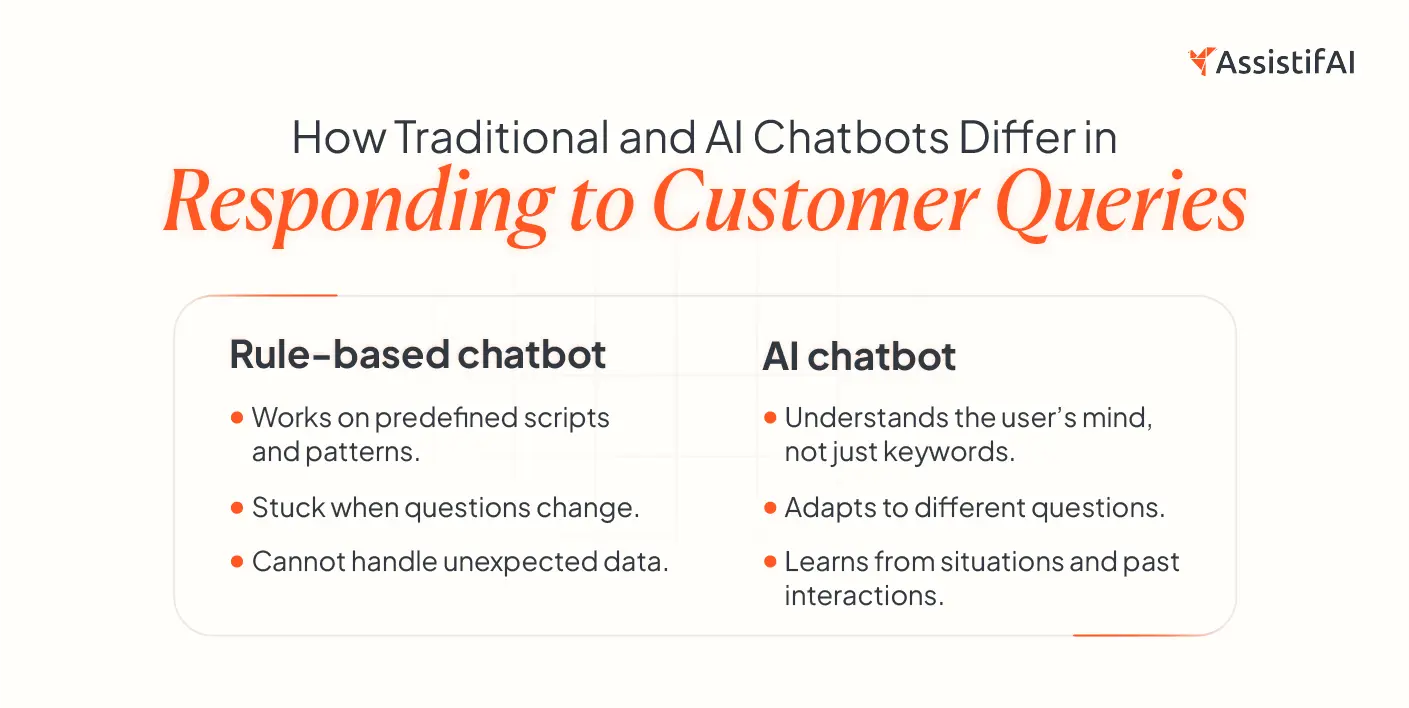
Older rule-based chatbots will not achieve any marketing goals for a business. When a rule-based chatbot simply handles the “Where is my order?” question, an AI chatbot handles “I ordered last week and haven’t received anything." " Can you check?”
That difference determines whether a user stays or leaves.
How does an AI Chatbot work?
At a basic level, an AI chatbot does three things:
1. Understand the query
It reads the input and identifies intent. AI chatbots use NLP to understand not just words but meaning, the context, sentiment, and intent behind user input, allowing for more human-like interactions.
2. Retrieve or generate a response
AI chatbots collect data from:
- Knowledge bases
- Product data
- Past interactions
- Pre-trained language models
3. Respond in real time
AI chatbots reply faster than your team ever can, without human input.
Natural language processing and machine learning models, along with connections to business systems, work behind the scenes.
Where do AI Chatbots actually help in Business?
Employees and customers are the two most important pillars of any business. Therefore, it is important to ensure a consistent, beneficial experience for these two stakeholders.
1. Customer Support System
Customers also depend on social media. An AI chatbot for customer service helps resolve issues quickly and keep track of all customer communications.
People leave because no one answers their questions.
An AI chatbot captures them in real time:
- Answers product questions
- Recommends solutions
- Pushes them toward conversion
2. Reduces Support Overload
AI chatbots provide immediate, round-the-clock responses, eliminating wait times and handling traffic spikes during peak seasons or holidays.
It handles:
- Order tracking
- FAQs
- Basic troubleshooting
3. Reduce Drop-offs in the Buying Journey
Assign AI chatbots to manual, time-consuming sales tasks and reduce abandoned shopping carts.
An AI chatbot can nurture prospects and potential customers through:
- Clarifies pricing
- Explains features
- Removes friction
4. Prevent Follow-Up Fatigue
Leads become unresponsive due to slow response times. The smart AI chatbot understands this and reduces delayed follow-ups by:
- Notifying customers about potential issues.
- Saving staff from repetitive manual tasks.
Why Every Business Needs an AI Chatbot in 2026?
Here is a case study showing the real impact of AI chatbots.
1-800-Flowers, a leading online store for flowers and gifts, uses an AI-powered chatbot called "GWYN" (Gifts With Your Name) to interact with customers quickly and easily. This chatbot can assist with order tracking, suggest products, and provide customer support.
The addition of chatbot AI led to a 30% increase in sales for the company and resolved 90% of queries.
Like such cases, more examples exist.
Customers Want Instant Replies
Customers can’t wait long.
When you delay the response by 2 hours, the customer is likely to leave your website and seek an immediate response from your competitor's website.
And the result is you are losing one lead.
Rising Cost Pressure
AI chatbots answer common questions instantly and accurately.
It can also reduce customer support costs by limiting agent dependency.
AI chatbots reduce:
- Hiring costs
- Training costs
- Operational overhead
Low Sales Cycles
Users arrive at faster decisions.
If your business isn't present at the time of decision-making, it doesn't matter.
The Problem of Fragmented Channels
Users interact across multiple platforms, like
- Websites
- Apps
- Other social platforms
AI chatbots unify these interactions.
What makes an AI Chatbot Effective?
Context matters
If your chatbot does not understand your product, it gives generic, unhelpful answers. Customers want to feel like the bot “gets them,” not like they're talking to a machine that misses the point.
And when that happens, that kills trust.
Speed matters
A slow chatbot defeats business targets. Customers are constantly looking for fast responses. When they don’t get what they want, it creates frustration and could drive them to search for your competitors. Quick and reliable service builds a positive customer experience.
Integration matters
The AI chatbot is craving for
- CRM data
- Order systems
- Knowledge bases
Without this, the chatbot becomes a dead-end. It's like having a helpful assistant but locking them out of the room with all the answers.
Control matters
Businesses need:
- Guardrails
- Approval flows
- Data control
Without this, risk increases. AI chatbots should align with business goals and standards.
How to Choose the Right AI Chatbot for Your Business?
Never choose an AI chatbot based on features. Look for problems.
1. What problem can it solve?
- Lead generation
- Customer support
- Sales conversion
Do not try to solve everything at once.
2. How fast can it deploy?
If it takes months to put it into action, you lose momentum.
Look for:
- Zero code setup
- Pre-trained templates
- Quick integrations
3. Can it handle real conversations?
Use messy queries for testing, not clean ones.
It will fail in production if it fails on real inputs.
4. Does it work with your stack?
Check compatibility with:
- Customer Relationship Management
- Helpdesk
- Messaging platforms
Without integration, there is no value.
5. How much control do you have?
You need to control:
- Data usage
- Responses
- Escalation rules
Blind automation is risky.
Common Mistakes Businesses Make with AI Chatbots
Poor assumptions lead to failures.
1. Treating it like a plug-and-play tool
AI chatbots want to know about context.
An improper setup gives weak answers.
2. Over-automating too early
Trying to automate everything leads to a poor user experience.
Start with high-impact areas.
3. Ignoring the user journey
A chatbot should guide users, not just respond.
If it does not move users forward, it is useless.
4. No fallback to human support
Not every query can be automated.
A clear escalation path is critical.
5. Measuring the wrong metrics
Don’t waste time on:
- Number of conversations
Track:
- Conversions
- Resolution time
- Cost reduction
What does the Future of AI Chatbots Look Like?
The change is crystal-clear.
AI chatbots are moving from
- Answering questions → Taking actions
- Supporting teams → Replacing workflows
In the next few years, they will:
- Complete transactions
- Resolve issues end-to-end
- Act as full-time digital agents
The gap between chatbot and employee will shrink.
Final Thoughts
Most businesses don't have a problem with demand. They have a problem with their response.
People are already coming. They are already asking. They are already showing what they want.
There is a lack of speed and clarity.
AI chatbots take care of that, not by adding another tool, but by speeding things up.
The real question is not whether you need one. How much longer can you wait without one? AssistifAI offers no-code AI-powered solutions for businesses, enhancing customer interactions with advanced chatbots that deliver 24/7 support.
AssistifAI helps businesses focus on more important things by automating routine tasks. It also gives customers a more personalized experience.
Ready to level up your customer service with AI?
Start your journey with AssistifAI today.
Frequently Asked Questions (FAQs)
1. What is an AI chatbot?
An AI chatbot is a software application that can understand user queries and respond in natural language, whether in text or voice.
2. Is the AI chatbot safe?
Every AI chatbot is designed for a specific purpose. It’s better to make sure chatbots follow strict regulations.
3. What steps should you take before using an AI chatbot?
Before using any AI chatbot, you should read its privacy policy, check its reputation, and set clear goals to make sure your data isn't misused.
4. What are AI chatbots for customer service?
AI chatbots in customer service provide instant support, minimize operational expenses, and increase sales. Also, they can handle multiple inquiries simultaneously, offer personalized recommendations, and operate 24/7.
5. How does an AI chatbot help businesses?
An AI chatbot helps businesses foster positive customer relationships with website visitors.
6. What differentiates an AI chatbot from a traditional chatbot?
While traditional bots follow rigid, pre-programmed rules, AI chatbots learn from natural language processing (NLP) and machine learning (ML) to provide more accurate human-like responses and handle complex tasks.

Read More Blogs

Your next hire isn't human.


AssistifAI automates your workflows and delivers exceptional voice and chat-based customer support helping your business grow faster, save time, impress clients, and stay ahead of the competition.